Revised models indicate the need to cut commercial quota by more than half to rebuild striped bass populations, but ASMFC Menhaden Management Board vote today reduces catch limit by a mere 20 percent
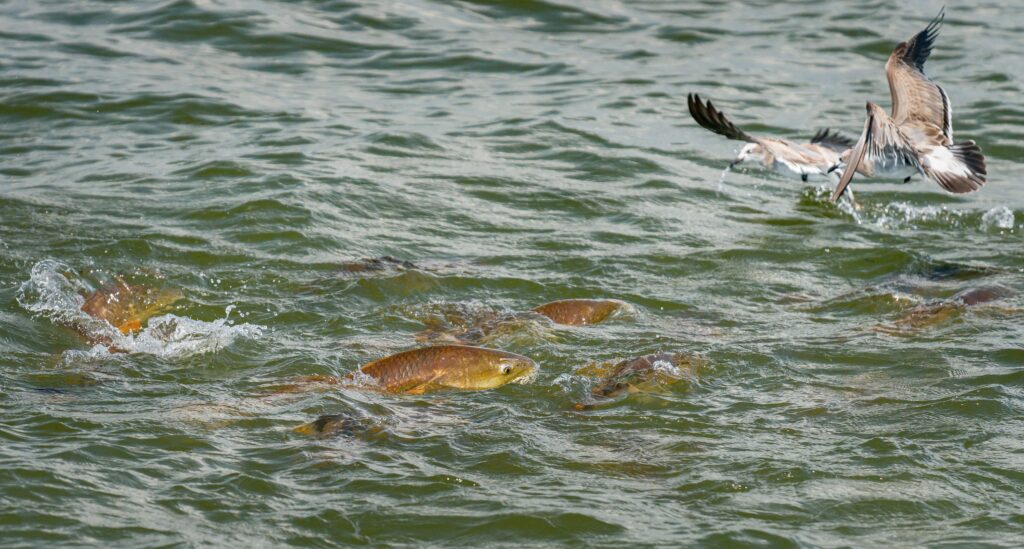
Despite a 2025 stock assessment indicating that Atlantic menhaden biomass is one-third lower than previously estimated – and an immediate need to cut the coastwide menhaden quota by more than 50 percent to support striped bass rebuilding – the Menhaden Management Board of the Atlantic States Marine Fisheries Commission voted today to reduce 2026 commercial catch by only 20 percent. The decision, which will likely prevent striped bass and other predators largely reliant on menhaden like bluefish, weakfish, spiny dogfish, and ospreys from having sufficient forage, was a disappointment for conservation and recreational angling organizations.
“Rebuilding the Atlantic striped bass population has always involved more than just regulating striped bass harvest. It’s also about ensuring that enough of their key food source, Atlantic menhaden, remains available in the water,” said Chris Macaluso, director of the Center for Fisheries for the Theodore Roosevelt Conservation Partnership. “The Menhaden Management Board’s decision to adopt only a 20 percent reduction in menhaden harvest, despite the science and input from ASMFC’s own scientists who highlighted the risks, makes it more challenging to achieve striped bass recovery by 2029. This step falls short of fully advancing more than a decade of progress toward ecosystem-based management and undermines public trust in the process.”
Three years ago, the Menhaden Management Board voted to increase the Atlantic menhaden catch limits for the 2023-2025 fishing seasons when the best available science indicated it was warranted.
The Board’s decision, made at the agency’s annual meeting in Delaware, ignores its own management framework based on “ecological reference points” (ERPs) — clear, science-based limits that tie menhaden harvest directly to predator health – and new estimates that show there are 37 percent fewer menhaden off the Atlantic coast than previously estimated. The Board also declined to vote for additional coastwide menhaden quota reductions beyond the 2026 fishing season, dodging additional quota cuts for 2027 and 2028 that could have collectively reached an ERP-based reduction that the recreational angling community called for after three years. The Board instead favored revisiting the issue in 2026 to determine if additional reductions are needed.
Notably, three years ago the Menhaden Management Board voted to increase the Atlantic menhaden total allowable catch for the 2023-2025 fishing seasons when the best available science indicated it was warranted. However, now that the best science indicates a reduction in catch is needed, the board has declined to reduce the catch to align with the ecosystem-based management model.
In early October, the ASMFC released its 2025 Atlantic menhaden stock assessment update, which indicated that the coastwide menhaden biomass is lower than previously estimated and suggested that slashing the coastwide catch limit by more than half would be necessary to ensure sufficient forage for rebuilding populations of striped bass. The Board’s decision today is not expected to achieve the standard 50/50 probability of not exceeding the ERP fishing mortality target – the precautionary approach that would dictate risk-tolerant, science-based management – and instead results in a 100 percent chance of exceeding the target in 2026.
“Today, the Menhaden Management Board chose to abandon ecosystem-based management and will be leaving less menhaden in the water to fuel our coastal ecosystems and sportfishing economies,” said Ted Venker, conservation director for the Coastal Conservation Association.
Unlike traditional single-species models that only measure the health of one species like menhaden, ERPs explicitly weigh the tradeoffs between menhaden harvest and effects on predator populations — in this case, most notably striped bass, also known as rockfish.
TRCP and partners successfully advocated for ERPs to be considered in menhaden management starting in 2020. The expectation of all involved in the process was that this methodology would drive future management decisions, even though following ERPs is not mandated for the ASMFC.
“We will continue working with the ASMFC, anglers, and conservationists to ensure that menhaden harvest reductions go beyond 20 percent and align with the ecosystem’s needs and the board’s stated commitments,” Macaluso said.
The Menhaden Management Board also voted today to initiate an addendum to specifically address Chesapeake Bay Management, which will develop options for quota periods which distribute menhaden removals more evenly throughout the fishing season, as well as options to reduce the Chesapeake Bay Reduction Fishing Cap ranging from status quo to a 50 percent decrease. This process could yield significant benefits to the Bay ecosystem, which has faced multiple concerns in recent years, including osprey breeding failures due to chick starvation in many parts of the Bay.
More information about the broad importance of Atlantic menhaden is available on TRCP’s Forage Fish Recovery Page.
Banner image courtesy David Mangum


This is another cover up. Someone is being paid off to allow this to happen over and over again. The science shows they need to reduce the menhaden catch by 50% and more. They need to completely stop all menhaden fishing within the entire area of the Chesapeake Bay. They are allowing nets to be laid across the narrowest part of the bay in Virginia which captures the majority of the menhaden that attempt to travel up the bay into Maryland. Maryland is where 80% of the striped bass spawn on the entire east coast. I have fished the bay for over 60 years and this has been getting worse year after year. You see very few schools of menhaden in the upper bay any more. Also you see very few osprey nests that have young birds this year. This has to stop. Stop Omega from fishing for menhaden within the Chesapeake bay. Only allow fishing 3 miles off the coast.
The marine fisheries commission is headed by the same company, omega protein they sit as the head of the board along with Daybrook fisheries! I have been in contact with one employee who was the computer guy for Omega protein since retired for 20 years! He basically told me all the science is manufactured by omega, protein scientist to say the industry is thriving while it has been in collapsing for 50 years! Everywhere the Menhaden boats go they kill all the fish, Passed NOAA Records show up to 50% by catch! Meanwhile, they have no observers, and we have to take their word for how much they catch! They have no limits in Mississippi or Louisiana! It is a crime against humanity is a crime against nature to do what the Omega boats do! It is against federal law through Jones act the very fabric that guards, American boating, American water, and American commerce, No foreign entity shall own an operate American boats in American water!
So now we have a Canadian company cook Inc. Owns Omega protein South African company owns Daybrook fishery so now we have foreigners killing all of our fish! We need a class action lawsuit against Virginia against Mississippi against Louisiana for allowing mass mismanagement of our natural resources
Omega protein has a well funded lobby in Washington DC. Call the Menhaden coalition. They have deep pockets and basically buy off all our politicians for the stamp to kill all our fish. It is criminal and it is what’s wrong with the basic fabric of this country.! They take ove 5000 pounds per person for every man woman and child on the Gulf Coast! They have more wrongful deaths than any industry. I can find one person in 350. The national average is one and 50,000! They pollute the same water, the fish and have been fine many times by the EPA! They mostly use foreign labor and spend millions on immigrants, Because the jobs are so bad locals won’t do it!