Our Issues
Public Lands
Why It Matters

Hunting & Fishing Access

America’s 640 million acres of national public lands provide irreplaceable hunting and fishing opportunities to millions of Americans.

Learn More About Access
What TRCP is Doing

We’re working to safeguard America’s public lands so hunters and anglers always have quality places to pursue their passions.

 Brian Flynn, Two Wolf Foundation
How Sportsmen Are Doing It Right

Brian Flynn, Two Wolf Foundation's Story

Following a distinguished career in the U.S. Army, lifelong outdoorsman Brian Flynn returned home from a deployment in Afghanistan and…


Hunting
Why It Matters

Key Issues for America’s Hunters

Your source for the latest policy updates, conservation challenges, and opportunities shaping America’s hunting traditions.

What TRCP is Doing

We’re fighting for meaningful policy changes that benefit wildlife, our waters, and the American landscapes that make our outdoor traditions possible.

 Ryan Sparks
How Sportsmen Are Doing It Right

Ryan Sparks's Story

TRCP’s “In the Arena” series highlights the individual voices of hunters and anglers who, as Theodore Roosevelt so famously said,…

Fishing
Why It Matters

Key Issues for America’s Anglers

Your source for the latest policy updates, conservation challenges, and opportunities shaping America’s fishing traditions.

What TRCP is Doing

We’re fighting for meaningful policy changes that benefit wildlife, our waters, and the American landscapes that make our outdoor traditions possible.

 David Mangum
How Sportsmen Are Doing It Right

David Mangum's Story

Capt. David Mangum is a YETI ambassador and outdoor photographer who utilizes his talents to produce media that inspire a…

Private Land
Why It Matters

Stewardship on America’s private lands

With 70 percent of U.S. lands in private hands and many of our best hunt and fish opportunities occurring there, investing in voluntary conservation on working lands safeguards access, strengthens habitat and water quality, and ensures resilient landscapes.

Learn More
What TRCP is Doing

We champion policies and programs that restore wildlife habitat, improve soil and water health, and keep working lands productive.

 Ward Burton
How Sportsmen are Doing It Right

Ward Burton's Story

Ward Burton’s NASCAR driving career stretched across most of two decades. As an avid sportsman and conservationist, he founded the…

Special Places
Why It Matters

Special Places Worth Protecting

America’s most iconic landscapes provide unmatched habitat and unforgettable days afield. These places sustain wildlife, anchor local economies, and define the hunting and fishing traditions we pass down.

What TRCP is Doing

We’re working to conserve special places that provide world-class habitat and unforgettable opportunities for hunters and anglers.

 Franklin Adams
How Sportsmen Are Doing It Right

Franklin Adams's Story

As a true Gladesman, conservationist, and historian, Capt. Franklin Adams has spent more than six decades championing Everglades restoration efforts…

Habitat & Clean Water
Why It Matters

Healthy Habitat Powers Every Pursuit

All hunting and fishing opportunities depend on quality habitat, from clean water and healthy wetlands to winter and summer habitats and the migration corridors that connect them.

All About Habitat & Clean Water
What TRCP is Doing

We are working to safeguard the habitats that power every hunting and fishing opportunity.

 Alex Harvey
How Sportsmen Are Doing It Right

Alex Harvey's Story

Alex Harvey, founder of Legacy Land Management, is a registered professional forester in Mississippi and Alabama with a Master's degree…

Science
Why It Matters

Science That Guides TRCP

From conserving migration corridors and wetlands to ensuring clean water and resilient landscapes, science provides evidence that turns conservation goals into effective action.

Science for Conservation
What TRCP is Doing

For hunters and anglers, science safeguards the experiences we treasure including resilient big game populations, abundant fish, and wild places that endure changing social landscapes.

Jamelle Ellis
Your Science Expert

Jamelle Ellis's Story

Jamelle Ellis joined the Theodore Roosevelt Conservation Partnership in 2022. Jamelle spent the last three years as an environmental sustainability…

Where We Work
Across the Nation

Conservation Across America

TRCP works across the country to ensure hunters and anglers can enjoy healthy fish and wildlife and quality days afield, no matter where they live.

See All Issues
TRCP in Your Region

TRCP works across the country to ensure hunters and anglers can enjoy healthy fish and wildlife and quality days afield, no matter where they live.

Who We Are
Our Mission

To guarantee all Americans quality places to hunt & fish

We unite and amplify our partners’ voices to advance America’s legacy of conservation, habitat, and access.

Our Mission & Values
Our People & Partners
  • Meet the TRCP Team

    Our staff and board members unite and amplify our partners’ voices to advance America’s legacy of conservation, habitat, and access.

    Meet the Team
  • Our Partners

    ‘Partnership’ is in our name. We work with 64 diverse partner groups that represent today’s leading hunting, fishing, and conservation organizations in order to strengthen the sportsman’s voice in Washington, D.C.

    Our Partners
  • Corporate Council

    TRCP’s Corporate Council is made up of diverse corporations that share a common passion for conservation.

    Corporate Council
Our Organization

Looking for more information?

Explore our latest news, policy updates, and conservation resources to get the information you need.

Giving
How You Can Help

To guarantee all Americans quality places to hunt & fish

Your tax-deductible donation will support TRCP's mission, now and into the future.

DONATE
Special Ways to support trcp
  • Capital Conservation Awards Dinner

    The CCAD is one of Washington's best-attended conservation celebrations, featuring dinner, cocktails, and a silent auction.

    Learn More
  • Step Into the Arena

    Help us ensure that our treasured wild habitats and game remain intact for the next generation to enjoy – lend your support to the TRCP’s efforts today!

    Donate
  • Roosevelt Roast

    TRCP has partnered with Afuera Coffee Co. to further our commitment to conservation.

    Learn More
More donation options

Find the best way for you to lend your support. Join one of TRCP’s donor circles for special invitations, premium offerings from outdoor retailers, and more exclusive benefits. Take control of your legacy with planned giving or contribute to special conservation funds.

Other Ways To Give
News
In the Spotlight

In the Arena: Josh Warren

For many hunters and anglers, the connection to conservation begins close to home — in the woods behind the house, along a familiar stretch of river, or through time spent learning from mentors and family. That sense of place is something Joshua Warren carries with him, both personally and professionally. As Director of Marketing at WorkSharp, Josh represents a company rooted in Ashland, Oregon, a community defined by its access to public lands and wild country.

Read More

Stay Informed

Receive our newsletter, the Roosevelt Report, right in your inbox. Never miss the latest news in conservation issues.

by:

posted in:

December 19, 2025

Feature

Do you have any thoughts on this post?

XHTML: You can use these tags: <a href="" title=""> <abbr title=""> <acronym title=""> <b> <blockquote cite=""> <cite> <code> <del datetime=""> <em> <i> <q cite=""> <s> <strike> <strong>

Comments must be under 1000 characters.

by:

posted in:

TRCP’s Madeleine West Brings Sporting Perspective to Western Governors’ Association Panel

VP of Western Conservation spoke on responsible energy siting. Watch the full panel discussion below.

This week, the Western Governors’ Association held the third workshop of Governor Spencer Cox’s Chair initiative, Energy Superabundance: Unlocking Prosperity in the West in Pheonix, Arizona.

Arizona Governor Katie Hobbs kicked off the workshop which offered a series of expert panels comprised of policymakers, conservationists, and industry leaders from across the West. Topics included the West’s growing energy demands and how these challenges can be addressed through streamlined permitting and siting processes, as well as the expansion of emerging energy technologies.

Madeleine West, TRCP’s VP of Western Conservation, participated in the Siting Considerations for Energy Development panel which discussed the challenges of siting energy infrastructure and considered strategies to improve responsible energy siting outcomes. 

“We recognize we need a diverse source of energy to meet our seemingly unquenchable energy needs in this country,” said West. “But we believe that can be done by also conserving the places where we love to hunt and fish and having sustainable fish and wildlife populations.”

Watch the full panel discussion below.

West emphasized that TRCP understands a diversity of energy sources is needed to meet our growing energy needs and reduce carbon emissions. However, many of these options require vast amounts of land, exclusionary fencing, and temporary or permanent disturbance that can impact wildlife directly, as well as sensitive habitats and working agricultural lands. Responsible siting policies must be in place that facilitate expanded deployment of diverse energy resources, while also guaranteeing quality places to hunt and fish

Joining West on the panel was Jason Baran, director of state government affairs for the Salt River Project; Kathryn Leonard, Arizona state historic preservation officer for the Arizona State Historic Preservation Office; Marc Reyes, director of interconnection and transmission for Fervo Energy; and Tom Vinson, vice president of policy and regulatory affairs for the American Clean Power Association.

West highlighted that fish and wildlife drive a robust and growing outdoor recreation economy, the benefits of which are driven largely in rural communities. These communities are also where much of the new energy infrastructure is being proposed, creating the need to support economic growth from energy development without sacrificing existing wildlife and land-driven economies.    

TRCP is working with partners in the hunt-fish community to build scientifically supported policy recommendations to ensure hunting and fishing traditions and growing outdoor recreation economies continue to thrive as energy demands are met.

This includes the Energy Development & Land Use: Fish & Wildlife Platform developed by TRCP and 21 other hunting, fishing, and conservation organizations; the Wildlife for the 21st Century, Volume VII (W-21) by the American Wildlife Conservation Partners, the nation’s top 52 sporting-conservation organizations; the Critical Minerals: A Hunting and Fishing Perspective report, developed by Trout Unlimited, Backcountry Hunters & Anglers, The Nature Conservancy, National Wildlife Federation, and the TRCP; and TRCP’s solar siting guidelines to summarize the emerging science to inform the siting of solar energy facilities in a manner that avoids, minimizes, and mitigates impacts to big game and their habitats.

by:

posted in:

December 18, 2025

2025 Forage Fish Conservation Wrap-Up

Late in the year, the menhaden reduction industry gained ground at dismantling hard-fought conservation wins for coastal ecosystems and sportfish populations. Where does that leave us now?

For our usual year-end forage fish wrap up, we decided this year to dive into the latest alarming menhaden regulatory decisions, what they mean, and let you know how you can continue to engage decision-makers to try to save the hard-fought, science-based wins that our angling and conservation community has worked so hard to put in place.

Atlantic Overview

As we reported two months ago, the Menhaden Management Board of the Atlantic States Marine Fisheries Commission voted in late October to cut the 2026 Atlantic menhaden quota by a mere 20 percent. This may sound like a lot, and while it is a moderate decrease, a revised stock assessment showed the menhaden population size is more than one-third lower than previously estimated, and that a cut of over 50 percent is necessary to ensure there are enough of these critical forage fish available in the water to support rebuilding the Atlantic striped bass population.

The decision to adopt a token reduction in the Atlantic menhaden catch quota disregards the science and input from ASMFC’s own scientists.

The Board also chose to only set the new quota for one year, rather than the full three years consistent with how the ecosystem-based framework is designed. This decision to adopt a token reduction in the coastwide quota disregards the science and input from ASMFC’s own scientists, abandons the Commission’s own ecosystem-based management framework, and undermines public trust in the ASMFC’s management decisions. In addition, even with this decrease in quota, it will likely not decrease coastwide harvest, negating the presumed conservation benefits that the cut could have.

From our perspective, the ASMFC’s decision:

1. Ignored the best available science in the stock assessment update, which showed that the Atlantic menhaden population is 37 percent lower than previously estimated, and that for years fewer forage fish have been in the water for predators to eat.

2. Abandoned the Commission’s own Ecological Reference Point (ERP) management framework, which indicated that even a quota cut of more than 50 percent would achieve only a 50/50 chance of not exceeding the ERP fishing mortality target. (See our earlier blog for an explanation of ERPs.)

3. Allowed one company operating in one state – Omega Protein, in Virginia – to overtly influence the coastwide decision-making process in their favor, to the detriment of not only the ecosystem, but other Atlantic states’ bait industries as well.

4. Disregarded the overwhelming majority of the public who commented in favor of a new quota that would have maintained the integrity of the ecosystem-based menhaden management framework (more than 1,100 opposition comments were generated through TRCP alone).

On a positive note, because this was only a one-year decision, TRCP will push for additional quota reductions in 2026 and 2027. Also, the Board did finally choose to initiate a process to address Chesapeake Bay menhaden management. Early next year, it will consider options for quota periods to distribute menhaden removals more evenly throughout the fishing season, as well as options to reduce the Bay’s reduction fishing cap, ranging from status quo to a 50 percent decrease.

The cap was put in place nearly two decades ago as a precautionary measure to protect predator diet needs in the Chesapeake, but due to industry opposition, efforts to gather data to justify any updates to the cap have been stymied. This process could yield significant benefits to the Bay ecosystem, which has faced multiple concerns recently tied to menhaden, including osprey breeding failures due to chick starvation.

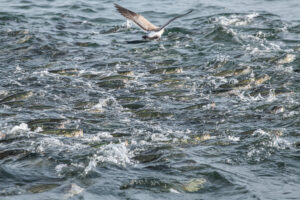
Menhaden serve as a critical food source for striped bass, ospreys, and many other predators. Credit: Sergio Diaz

What’s Next for Atlantic Menhaden?

In February 2026, or at the latest, by next summer, the ASMFC should publish the draft addendum for public comment regarding Chesapeake Bay management. It’s imperative that you participate in that public process by submitting comments virtually or in-person at future public hearings. The TRCP and partners will be fully engaged in advocating for options that conserve menhaden for its environmental role in the Bay to sustain striped bass, osprey, and other predators – and we will be sure to provide more information on how you can take action next year.

Gulf Overview

As we reported last month, after facing intense industry pressure, the Louisiana Wildlife and Fisheries Commission voted to proceed with a Notice of Intent (NOI) that is slated to reduce a half-mile buffer zone for industrial menhaden fishing off Louisiana’s coast to just a quarter-mile in most locations. This change could allow industrial menhaden harvest in waters as shallow as five feet—undoing a compromise reached in 2024 between anglers, conservation groups, the menhaden industry, and state officials. After a one-month public comment period, the NOI will move to natural resource committees in the state legislature for approval, where lawmakers have the ability to reject the proposed changes.

After a half-mile buffer restricting industrial menhaden fishing near Louisiana’s coast was put in place, fish-kill incidents declined by 81 percent.

The current buffer was established following multiple fish spills caused by menhaden harvest nearshore in 2023, with torn or overfilled nets wasting over 2.5 million menhaden and killing thousands of breeding-size redfish that washed up on public beaches. We calculated that after that buffer was put in place in 2024, fish-kill incidents declined by 81 percent in 2024-2025, compared to historical averages.

Also, a 2024 study found that approximately 150 million non-target fish are caught as bycatch each year by the menhaden industry, including 30,000 redfish and hundreds of thousands of other predators like spotted seatrout (speckled trout), black drum, and jack crevalle, as well as 25-million-plus sand seatrout, commonly called white trout. The Commission’s decision in November completely ignored this disturbing information, undermining public trust in Louisiana’s fisheries management. This move threatens fragile coastal habitats and fish populations in Sportsman’s Paradise and risks reversing the gains we have made to protect the forage fish base in the Gulf, which supports key sportfish populations and nearshore ecosystems.

What’s Next for Gulf Menhaden?

From now through Jan. 23, 2026 this NOI will be open for public comment that will be considered by the LWFC. Comments can be submitted directly to Jason Adriance, LDWF’s finfish program manager, or using the TRCP’s action alert system HERE.

Take action by telling the LWFC not to roll back the buffers:

TRCP also is providing another means to potentially reverse the NOI decision. You can sign a separate alert targeting state lawmakers asking them to reject the NOI.

Take action by urging lawmakers to reject the NOI:

We need your help by signing both alerts to let lawmakers and the Commission know that you oppose any rollbacks to the current buffer zones, to protect Louisiana’s nearshore ecosystems and public fisheries. We cannot let the menhaden industry bully the LWFC and Commissioners into making management decisions solely for their benefit. The Commission cannot responsibly abdicate its responsibility to serve all the people and natural resources of Louisiana.

Thank You for Your Support

Only together can we ultimately achieve long-term menhaden conservation to support recreational fishing and healthy coastal ecosystems. We appreciate your ongoing and necessary support. As always, feel free to reach out to our team at any time.

Banner image courtesy Joanna Steidle

by:

posted in:

Bipartisan Wildlife Road Crossings Program Reauthorization Bills Introduced in Senate

Companion bill was introduced in the House of Representatives in November

The Theodore Roosevelt Conservation Partnership applauds Senate introduction of two bills that would reauthorize and increase funding for the Wildlife Crossings Program through fiscal year 2031.

Senators Alsobrooks (D-Md.), Cramer (R-N.D.), Merkley (D-Ore.), and Curtis (R-Utah) along with Senators Heinrich (D-N.M.) and Sheehy (R-Mont.) are leading legislation in the Senate. In November of this year, Congressmen Zinke (R-Mont.) and Beyer (D-Va.) introduced similar legislation in the House.

The Wildlife Crossings Program provides grant funding to state and Tribal governments to construct wildlife crossings such as overpasses, underpasses, and fencing. This infrastructure has proven to significantly reduce the number of wildlife-vehicle collisions and improve habitat connectivity.

“Wildlife crossings on America’s highways increase motorist safety, ensure habitat connectivity, and save countless dollars by preventing vehicle-wildlife collisions,” said Joel Pedersen, president and CEO of the Theodore Roosevelt Conservation Partnership. “TRCP applauds Senators Alsobrooks, Cramer, Merkley, Curtis, Heinrich, and Sheehy along with Representatives Zinke and Beyer for their foresight and leadership to introduce legislation that would increase public safety while supporting the wildlife populations that American sportsmen and women depend upon.”

Learn more about TRCP’s commitment to wildlife migration conservation HERE.

by:

posted in:

Deer Season: Hunting & CWD — Reflections from a Pennsylvania Deer Season 

A season-long reflection from TRCP’s Jim Kauffman on hunting Pennsylvania and doing our part to help manage chronic wasting disease.

In Jim Kauffman’s first Pennsylvania installment in TRCP’s Deer Season: Hunting & CWD series (Deer Season – Hunting & CWD: Prepping for the Pennsylvania Season), the focus was on preparation—scouting, planning, and understanding the steps hunters can take before the season begins to help curb the spread of chronic wasting disease. But responsibility doesn’t end when the season opens. As the weeks unfold and tags are filled—or go unpunched—hunters make decisions in real time that directly affect herd health, hunting traditions, and the future of deer hunting itself. Jim’s second installment follows a Pennsylvania season from early archery through rifle, showing what it looks like to balance time-honored deer camp traditions with the everyday choices that help support and protect healthy deer herds.

I missed. I stood there dumbfounded as the buck slowly meandered away. For four straight days I sat in that same tree, without seeing a single deer. But my preseason scouting convinced me that a buck would show if I hung in there. And when he did, I blew it. My arrow deflected off a small twig and embedded itself within the shallow Pocono mountain soil just underneath the deer. In the big woods of Pennsylvania’s public lands, opportunities at mature buck are fleeting, so when the time comes, execution is paramount. I would not sleep much that night back at camp, but I was thankful that my errant arrow cleanly missed. Moments like that are part of every deer season – but what happens before and after those moments matters just as much for the health of the herd and the future of our deer hunting tradition. 

Early Archery Season 

As it often does, archery season in Pennsylvania started off warm. To shake off the rust I began the season hunting a small private parcel close to home, hoping to fill my local doe tags. As luck would have it, the deer were moving in the evenings despite the heat. I was fortunate to take two mature doe early in the season, ensuring a good start to filling our freezers. I enjoyed the spoils of fresh deer steaks on the grill, making sure to share some venison with my friends that graciously allowed me to hunt their property.  

The Rut

With the progression of deer seasons, the decisions that hunters like us make – where to hunt, what to harvest, and how to handle animals afterward – remains important. As I shifted between regions, I continued to consult PGC CWD guidelines to ensure I was prepared for proper carcass handling in the event of a successful hunt. 

As the whitetail rut approached, I headed to the Poconos to spend my typical deer and bear archery week climbing trees on public land. Acorns were prevalent, and deer were on the move-they were just moving everywhere that I wasn’t. After a few days, I settled on a location where I would ride out the week, feeling good that the sign and topography would produce a buck within bow range. And after four days in that tree, I got my opportunity. But thanks to that one small twig, my hopes of taking a good buck on public land with the bow were quickly dashed. 

Throughout the remainder of the archery season I spent time between my friend’s local private parcel and our hunting camp in the northern tier. Although I was unsuccessful, I did have opportunities at some smaller bucks that I decided to pass, and we had two guests at our camp take nice bucks with the bow. The inclusion of Sunday hunting throughout archery season enhanced our trips to camp, allowing us to do more hunting during a quick weekend trip. And fresh venison on the camp skillet certainly added value to the experience. Because CWD has not yet been detected in some areas of Pennsylvania, it is still possible to enjoy a fresh venison meal before waiting for test results-although the risk of eating CWD positive meat still remains.  This reality underscores the importance of staying informed about evolving CWD science, testing guidance, and Disease Management Areas. As CWD spreads into new areas of the state, the experience of cooking fresh venison and the value associated with this time-honored tradition could be lost.  

Sika Camp

Traveling to hunt comes with added responsibility, especially when it comes to preventing the spread of CWD across state lines.

In early November, I joined some friends to hunt sika deer on the Eastern Shore of Maryland. Before I headed south, I consulted the guidelines for transport of cervid parts into Pennsylvania and reviewed Maryland’s regulations. To deter further CWD introductions, Pennsylvania prohibits the importation of high risk cervid parts from other states and provinces, unless the animal goes directly to a Game Commission approved cooperator. As a result, I developed a plan to adhere to these regulations if I were to take a sika during our hunt. As luck would have it, I was fortunate enough to take a mature stag with the bow after two days in the marsh.  I located a PGC-approved cooperator close to my home and dropped off the head to be processed for a European mount. And because CWD has not yet been detected in Dorchester County, we were able to enjoy some fresh sika steaks at camp-and they were as good as advertised.

Rifle Season

With rifle season on the horizon, we headed north to hunting camp, a rite of passage for many Pennsylvania hunters. The public lands of Pennsylvania’s northern tier are wild and rugged, dotted with historic hunting camps-many of which have stood for over a century. Deer camp is a time-honored tradition that we look forward to each year. The hunting is hard, but that’s what makes it rewarding.  

Much of northern Pennsylvania received a blanket of snow prior to the season and we had seen some good bucks during bear season-so we were excited to get back up to camp. Unfortunately, luck was not with us. We had seven hunters in camp and could not even see a single deer between our group. After four days of braving cold, snowy, ‘deer-less’ sidehills, we decided to break camp and head home.  Thus is the challenge of hunting Pennsylvania’s big woods public land. 

Upon returning home I shifted gears to prepare for a hunt on local public lands that I had scouted earlier in the fall. The habitat looked good, deer sign was plentiful, and my cameras showed some good buck cruising during the rut. Temperatures continued to fall and snow began to accumulate, creating great deer hunting conditions. After an exciting morning hunt, I caught up to nice 8-pointer that I was fortunate to connect on. Unfortunately, I was over two miles from the truck, so it would be a long extraction. After resting my legs, I removed the antlers and bagged the head to drop him off at a CWD headbin testing site. Despite being outside of a DMA, I wanted to ensure that I was doing my part to contribute to CWD surveillance and avoid consuming CWD-infected meat. With a successful hunt, my attention shifted from opportunity to responsibility, making sure my actions supported CWD surveillance and the long-term health of the herd. I chose to wait to consume the meat until test results were available – a simple step we can all take that helps protect hunters, families, and healthy deer populations.  

As the rifle season waned, I joined a couple small crews in an effort to push deer to friends and family. Our public land drives didn’t yield any kills, but we had some action and saw some beautiful country. On the last day of the season, I had the opportunity to push a private farm in hopes that some friends would fill their doe tags. And as luck would have it, a father and son in our crew would both harvest doe that day-a pretty special way to end the season.  

The conclusion of deer season is always bittersweet. We look back at the miles, the memories, and the heartbreaks with fondness, storing photographs and stories for the deer camps to come. We wait all year for it to arrive, and just like that, it’s over. Some seasons are better than others, but each is unique and memorable if you focus on what really matters.   

The value of deer hunting lies in the experience as a whole. The forests, the game, the friends and family, the photos, the stories, and the meals that these animals provide. When you remove any piece of that puzzle, you lose the total value of the experience.  

If CWD continues to spread and prevalence rates increase, we run the risk of losing the opportunity to hunt robust, healthy deer herds and enjoy the fruits of our labor with some incredible fresh table fare. By being proactive as hunters, we have the opportunity to help manage this disease by following PGC recommendations that prevent further spread and aid in detection. Adhering to these guidelines will ensure that we don’t lose the deer that we so passionately pursue, but we retain the parts that matter just as much-the stories, the laughs, and the time spent afield with friends and family.  

That balance – between tradition and responsibility – is at the heart of sustaining deer hunting for the long-term. Protecting healthy deer herds requires hunters to stay engaged beyond the shot, whether that means following transport rules, participating in testing, or sharing best practices with others at camp and at home. By taking these steps, hunters help ensure that the experiences, meals, memories, and stories that define deer season remain part of our lives for generations to come. It’s how we safeguard not only the deer we pursue, but the quality places to hunt and the traditions that make the season matter in the first place. 

Deer Season – Hunting and CWD.

This new TRCP series shares the personal deer hunting stories of three staff members while exploring the practices aimed at addressing the spread of chronic wasting disease. This season, we invite you to follow along and take part in preserving what we love most about deer hunting. 

As deer seasons open across the country, hunters are packing gear, checking maps, and preparing for the moments that define another fall outdoors. But today’s deer hunters face new challenges – chief among them, the spread of Chronic Wasting Disease (CWD), a 100-percent fatal neurodegenerative wildlife disease that affects members of the deer family. While more and more hunters are finding CWD in their backyards, it remains a source of confusion for many.  

From pre-season prep and regulation changes to lessons learned in the woods and around deer camp, Deer Season – Hunting and CWD will show how everyday hunters are part of the solution. Along the way, you’ll find tips, resources, and reflections that tie together our love of the hunt with our shared responsibility to keep deer herds healthy for future generations. 

Learn more about Chronic Wasting Disease here.

HOW YOU CAN HELP

TRCP has partnered with Afuera Coffee Co. to further our commitment to conservation. $4 from each bag is donated to the TRCP, to help continue our efforts of safeguarding critical habitats, productive hunting grounds, and favorite fishing holes for future generations.

Learn More

You have Successfully Subscribed!

You have Successfully Subscribed!

You have Successfully Subscribed!

You have Successfully Subscribed!