From handwritten memories to new milestones afield – TRCP’s Ryan Chapin reflects on passing on the hunt while staying informed and committed to good CWD stewardship in Montana.
In Montana, the Youth-Only Deer Season marks the start of big game hunting for many families. Public schools close for teacher-in-service days, giving kids ages 10 to 15 the first crack at harvesting deer with a firearm. This camp has become a rite of passage for our kids and some of their friends, and a tradition that we all look forward to.
While preparing for this year’s camp, I unexpectedly found a hunting journal that I started years ago when I was a youth hunter myself in my home state of Ohio. At the garage work bench, I turned on a light and opened the binder’s Velcro clasp and flipped through my handwritten notes and sketches.
I read one of the entries: “September 5, 1994 – Tomorrow Dad, Austin and I will set a stand at Bickley’s in the corner near the apple trees…”

These memories reminded me of how deeply rooted this tradition is for me and how pleased I am now to be passing it along to our kids and their friends.
Using the same pencil that I hadn’t touched for over 31 years, I wrote:
“October 14, 2025 – Tomorrow, my daughter Ella, her friend Addie and I will join our friends in setting the annual Youth Deer Hunting camp on Rock Creek…”
While setting up camp the next day, I thought of how much of hunting is the same as when I was a kid; lanterns still whisper, and wood stoves still cast warm flickers of light. I also thought about how hunting has changed since my childhood. Today’s hunters come equipped with range finders, digital phone maps, boots that are actually waterproof, and CWD sample kits from local game and fish offices.
Still, the hum of the modern hunting season carries a new awareness. Chronic wasting disease looms in conversations and decisions alike, reminding us that stewardship means more than just taking a clean shot – it means staying informed, testing our harvests, and helping safeguard the future of the hunt.
After camp was set, we planned out the hunt while roasting hot dogs over an open fire. Over the next several days, each group would take a different location to maximize the girl’s chances of success. Our group hummed with excitement, and I thought about how nice it was to be back here along the creek among friends, family and the towering ponderosa pine.
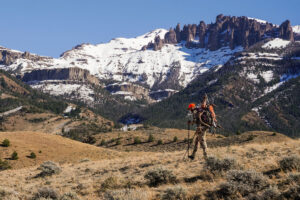
In the early morning dark, Addie, Ella and I went out on the big ridge to where the cliff overlooks the creek bottom. Addie, who’s joined the camp for years as a non-hunting companion, just recently took hunter’s safety and honed her shooting skills with us at the range. Ella and I admired her determination, her sharp eye for spotting animals, and her interest in becoming a hunter; we were keen on helping her get her first deer. We settled into the rocks and waited for the sun to rise.
Not long after shooting light, Addie tapped Ella on the shoulder and tugged on my coat’s hood to get our attention.
“There are two deer below us in the rocks by the river,” Addie whispered while pointing straight ahead and down.

Ella nor I could see the deer until their tails flickered white and moved away before a shot could be set up. We were impressed with Addie’s keen eye; while also a bit embarrassed that we couldn’t see the deer ourselves.

Over the next hour, Addie followed the same routine two more times, seeing and pointing out deer unseen by Ella or me. I rubbed my eyes, gave Ella a concerned look and whispered to Addie.
“The next deer you see, just get it in your scope fast and don’t worry about showing us!”
Before we knew it Addie was at it again, but this time she pivoted her body and the rifle to the left. Immediately we saw the deer coming our way along the creek bottom. Ella ranged the deer at 160 yards, and I helped Addie switch the rifle’s safety to fire and increase the magnification of the scope. Addie focused in and her shot was good. The deer collapsed on the spot. She rolled away from the rifle and grinned. Ella was there with high-fives and praise for a job well done.
We gathered our gear and walked down off the cliff following the water to where the dead deer lay in the tall grass. Addie punched her tag, and we got out knives. We could see the other hunters coming our way as they must have heard the shot.

Addie asked, “Ryan, do we have to leave the brains and spine behind like we did in Eastern Montana?” Referring to a guideline that applied at one time to certain hunting districts in Montana.
“Not here Addie, we will drag the deer out whole and dispose of the carcass. Also, we will take a lymph node sample and make sure your deer tests negative for CWD before cooking burgers and steaks, how does that sound?”
Addie nodded and explained that she learned about carcass disposal in her recent hunter’s safety class.

The rest of the girls arrived and rallied around her. They helped with the field dressing, offered congratulations, and worked together to drag the deer out to the road. It was satisfying to see young hunters supporting one another and seeing in real time one of human’s oldest skills being passed to another generation.
During the rest of our time at deer camp, Ella and Ava each also harvested deer and were supported by their friends with the same encouragement and camaraderie. As we packed up and headed home, I was pleased with how my relationship with hunting has evolved. From scribbling notes in my first hunting journal to watching a new generation carry the tradition forward. As we left camp, I felt a quiet responsibility settle in; the kind that comes with knowing our tradition is alive, and that it’s ours to pass on.
As we unpacked gear back home, I thought about how much I’ve learned since those early journal entries – less about taking deer and more about taking care. Each season, I study the Montana Fish, Wildlife & Parks hunting regulations booklet and CWD updates before heading out, check which units require sampling, and make sure our family has fresh sample kits and knows the rules for carcass transport and disposal. On the lands we hunt – from the river bottoms to the timbered ridges – I’ve come to see these steps not as burdens, but as part of the hunt itself: another way to respect the resource and the places that give us so much. Staying informed, testing our deer, and cleaning our gear are small acts that help ensure these same camps, lanterns, and early mornings remain part of the next generation’s hunting stories.
When the season ends and the freezers are (hopefully) full, I’ll take a quiet moment to look back on what we learned about the deer, the land, and ourselves, and just maybe, I’ll keep that old journal close by and start writing in it again.


Deer Season – Hunting and CWD.
This new TRCP series shares the personal deer hunting stories of three staff members while exploring the practices aimed at addressing the spread of chronic wasting disease. This season, we invite you to follow along and take part in preserving what we love most about deer hunting.

As deer seasons open across the country, hunters are packing gear, checking maps, and preparing for the moments that define another fall outdoors. But today’s deer hunters face new challenges – chief among them, the spread of Chronic Wasting Disease (CWD), a 100-percent fatal neurodegenerative wildlife disease that affects members of the deer family. While more and more hunters are finding CWD in their backyards, it remains a source of confusion for many.
From pre-season prep and regulation changes to lessons learned in the woods and around deer camp, Deer Season – Hunting and CWD will show how everyday hunters are part of the solution. Along the way, you’ll find tips, resources, and reflections that tie together our love of the hunt with our shared responsibility to keep deer herds healthy for future generations.