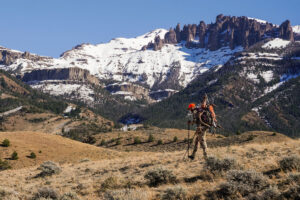
Mike-and-bighorn-sheep
Do you have any thoughts on this post?
Recap highlights what’s possible when agencies collaborate – and what the state can do in 2026 to conserve big game migration corridors, seasonal habitats, and the hunting traditions they support.
As we approach another Colorado legislative session, the TRCP is working to identify the most promising pathways for continued conservation and management of important big game habitat to ensure quality hunting opportunities continue for generations. Governor Polis, and several state agencies under his leadership, have made habitat conservation a priority during his time in office. In the final year of this administration, there are a few notable opportunities to cement meaningful conservation gains for the future.

Staff from Colorado Parks and Wildlife (CPW), Colorado Department of Transportation (CDOT), U.S. Forest Service (USFS), and U.S. Bureau of Land Management (BLM) led the charge on many of the hard-won conservation accomplishments of the past four years, and we want to recognize and celebrate these collaborative successes.
The most noteworthy advances include CPW’s expanded big game migration mapping work, the release of CPW’s 2024 Habitat Conservation and Connectivity Plan, CDOT’s planning and construction of new wildlife crossing infrastructure across the state, USFS’ management to conserve big game populations in the 2024 GMUG National Forests plan update, and the 2024 completion of BLM’s Resource Management Plan Amendment for Big Game Habitat Conservation for Oil and Gas Management. The TRCP supports science-based decision making, and having reliable, up-to-date information and planning tools underpinning agencies’ and elected officials’ actions is essential.
Because wildlife habitat overlaps all land management jurisdictions in Colorado, achieving conservation success is dependent on other state agencies, federal agencies, and local governments also utilizing CPW’s big game migration and habitat maps and science-based best management practices to inform their land use and development decisions.

To ensure lasting conservation benefits from this work, decision-makers could endorse targeted changes to select state, local, and federal policies to keep tens of thousands of acres of the most important seasonal deer, elk, bighorn sheep, and pronghorn habitats intact. For hunters, these safeguards would help sustain healthy herds and the opportunities, traditions, and access that depend on them. In a joint report from the Colorado Department of Natural Resources and Colorado Department of Transportation, the 2021 Colorado Big Game Policy Report identified pressing threats to Colorado’s big game populations and recommended policy solutions to address and alleviate the documented threats.
For example, if state and federal agencies and local governments ensure that new development for energy generation, energy transmission, and outdoor recreation infrastructure avoids the most sensitive big game habitats when possible, that will directly conserve wildlife populations and the open spaces that Coloradans love, while still allowing for important development projects to be built in suitable places. Additionally, allocating funding for wildlife crossing projects would reduce wildlife-vehicle collisions and facilitate wildlife movement across Colorado’s busy highways.
The majority of Coloradans surveyed in the 2025 Conservation in the West Poll believe that fish and wildlife habitat loss and population declines, and the loss of natural areas, are an extremely or very serious problem. And in 2024, CDOT responded to 3,777 crashes involving wildlife, so addressing the needs highlighted above would greatly benefit all Colorado motorists, wildlife populations, and future hunting opportunities.
“Successful conservation of big game migration corridors and seasonal habitats requires collaboration between many different people, and it requires deliberate planning and funding,” said Liz Rose, Colorado program manager for the TRCP. “There is a lot to celebrate when it comes to big game conservation in Colorado, and there are still exciting, meaningful opportunities to capitalize on that could alleviate our most pressing, current threats.”

Coloradans value wildlife, natural open spaces, and strong economies, and the state can set the bar high to advance conservation, recreation, industrial, and residential development needs for the future. We aren’t creating more habitat, but there are promising opportunities to ensure we conserve what remains. TRCP, alongside our great partners in Colorado, continues to urge state, federal, and local government decision makers to incorporate science-based best practices and Big Game Policy Report recommendations into their planning, management, and development policies. For hunters, anglers, and conservation-minded Coloradans, these kinds of policy changes would directly benefit big game herds and the future of the outdoor traditions they cherish.
Together, we must build the collective political will to steer development to locations where adverse impacts to Colorado’s iconic wildlife herds and citizens will be lower, and to manage the timing of land development and use to reduce impacts. Colorado has and will continue to prove that it is possible, beneficial, and popular to do so.
Top photo: Josh Metten
Last week, we posted a similar blog focused on misinformation coming from the menhaden industry on the Atlantic. In this blog, we’ll focus on misinformation peddled by the industry in the Gulf.
The menhaden reduction industry has benefitted from recent decisions affecting fisheries management on the Atlantic and Gulf coasts – with science-based cuts to catch quota being ignored and buffers that protect nearshore habitat and reduce bycatch slated for reduction. These decisions were guided by politics much more than science or public support. And that’s a problem, because menhaden are critically important bait fish that are preyed on by gamefish like redfish and tarpon, and sportfish like speckled trout, jacks, mackerel, and striped bass and serve as a necessary foundation for healthy ecosystems.
Despite these discouraging outcomes, the menhaden industry is seeking public sympathy in interviews with the media and in public hearings, complaining about financial woes and potential industry job cuts while boasting that they are committed to sustainable fisheries and healthy ecosystems. But is any of that actually true?
Recreational anglers and conservationists need to stay informed of the facts in the ongoing debate around menhaden management in the Atlantic and Gulf. Understanding complex fisheries management concepts is also important even when just assessing menhaden reduction industry-generated talking points in the “news” (which often isn’t news at all, as 2025 has seen a landslide of paid placements or “sponsored content,” and claims unvetted by journalists that appear on well-known news websites with only small disclaimers attached).
These misrepresentations matter because they’re already influencing management choices. One of the most consequential – and concerning – developments is happening right now in Louisiana.

Two weeks ago, under industry pressure, the Louisiana Wildlife and Fisheries Commission (LWFC) voted to proceed with a Notice of Intent to reduce an existing half-mile buffer zone preventing industrial menhaden fishing near Louisiana’s coast to just a quarter-mile in most locations. This decision disregarded data that show the half-mile buffer is preventing fish kills that waste hundreds of thousands of menhaden (more commonly called “pogies” in the Gulf) as well as thousands of redfish and other pogy predators annually. It also largely ignored a recent study that showed industry bycatch of redfish and other important gamefish species is more likely in shallower, near-shore waters.
Below are menhaden reduction industry claims we’ve seen in the media and/or in public meetings recently that require clarification.

Industry Claim (from LWFC meeting on Nov. 6): “The current buffer zone is cutting profits and workers’ jobs are at risk. Our fleet can’t catch enough fish elsewhere besides the area within a half-mile from shore to make enough money to maintain our financial performance.“
This claim is blatantly false, according to NOAA Fisheries data.
Industry Claim: “The results of a 2024 bycatch study funded by Louisiana ‘reaffirm what decades of science have consistently shown: Louisiana’s Gulf menhaden fishery is sustainable, selective, and not a threat to red drum populations.’”
This claim is short-sighted.

Industry Claim: “The fishery harvests less than 2 percent of the total Gulf menhaden biomass – helping to maintain ecological balance while preserving a key food source for marine predators.”
This claim does not tell the full story.
We know fisheries science and management definitions, concepts, and outcomes can be hard for anyone to understand, making it difficult to determine the best decisions for fisheries we care about. We encourage you to reach out to TRCP if any fisheries jargon ever needs to be better explained to help protect menhaden and the sportfish that depend on them.
Stay tuned for information about how you can weigh in on upcoming menhaden management decisions to shape where the fishery is headed. Learn more about these small fish with a mighty purpose by visiting TRCP’s Forage Fish Recovery Page
Banner image courtesy David Mangum
Investments to conserve, restore, and manage fish and wildlife pump billions into the economy – fueling jobs, powering the $1.1 trillion outdoor recreation industry, and rivaling major U.S. sectors.
A new report titled, “Conservation Economy in America: A Snapshot of Total Fish and Wildlife-Associated Direct Investments and Economic Contributions,” reveals that fish and wildlife conservation generates substantial economic benefits. Federal, state, local, and nonprofit contributions combined contributed $115.8 billion in total economic activity and supported over 575,000 jobs nationwide. Leading conservation organizations across the country applauded the findings, underscoring the report’s importance for America’s economy, communities, and natural resources.
“Conservation is an investment in America’s future and the bedrock of economic growth in communities nationwide,” said Joel Pedersen, president and CEO of the Theodore Roosevelt Conservation Partnership. “This report makes clear that the principles of stewardship and collaboration that built our nation’s conservation legacy continue to drive prosperity today. By supporting proven programs that restore habitat, enhance resilience, and expand access, Congress and the Administration can deliver lasting returns for people, wildlife, and local economies alike.”
The report finds that $55.3 billion in direct spending on conservation – including habitat restoration, fish and wildlife management, and expanded public access – forms the foundation of the nation’s $1.1 trillion outdoor recreation economy. These conservation investments generate powerful economic returns, adding $76.6 billion to the U.S. Gross Domestic Product (GDP) and $16.3 billion in tax revenues for state, local, and federal governments. Simply put, the outdoor recreation economy doesn’t happen without conservation – its contributions are the bedrock upon which all outdoor recreation depends.
“Hunting and fishing alone contribute nearly $400 billion annually to the United States economy, and sound financial investments into conservation are the backbone of our uniquely American sporting traditions and this important sector of the economy,” said Congressional Sportsmen’s Foundation President and CEO Jeff Crane. “Investments into conservation not only bolster fish, wildlife, and their habitats, but they also strengthen hunting and fishing opportunities for sportsmen and women across the nation, a win-win for our economy and our natural resources.”
The federal government was the leading source of conservation investments, accounting for approximately 48% of all spending. Its share, however, has been declining, even as state and local governments now provide 45% of spending – reflecting a shrinking portion of federal contributions to total conservation funding.
Together, these investments generated tax revenues on par with the video game industry – underscoring conservation’s powerful return for communities and the economy alike, while simultaneously preserving biodiversity and strengthening long-term growth.
Read the full report HERE.
“This report is a crystal-clear illustration that conservation investments stimulate the economy, from Wall Street to Main Street,” explained Marilyn Vetter, President & CEO of Pheasants Forever and Quail Forever. “These numbers tell the story of the conservation industry’s exponential effectiveness at turning each dollar into an economic ripple large enough to amplify our nation’s GDP. Just as important are the on-the-ground dividends of these investments, the habitat, wildlife, and water that benefit us all—hunters, anglers, families, and communities.”
“Theodore Roosevelt once proclaimed, ‘There can be no greater issue than that of conservation in this country,” said Gray N. Thornton, president and CEO of the Wild Sheep Foundation. “This captures the essence of Roosevelt’s commitment to conservation, emphasizing both the environmental challenges of his time and the timeless relevance of his vision. He recognized that human activities threatened natural resources, and he advocated for their responsible management to ensure that future generations could enjoy the benefits of nature. Today, as the report highlights, conservation not only serves ecological purposes but also holds significant economic value. The sustainable use of natural resources can support economies while preserving the environment, reflecting Roosevelt’s original intent to protect wild lands and wildlife for the enjoyment of all. This dual focus on ecological integrity and economic prosperity underlines the importance of effective conservation efforts in contemporary society.”
“For the many Americans who have experienced the life-changing power of the outdoors, the conservation of our country’s wildlife and wild places is self-evidently one of the greatest aspects of our nation,” said Jason Burckhalter, National Wild Turkey Federation co-CEO. “This report emphasizes how conservation efforts bolster our beloved traditions and enrich our experiences outside and it illustrates how our conservation efforts create a powerful engine for our nation’s economy. It is imperative that our elected officials see both the importance of investing in conservation, from our vital natural resources to our nation’s economy. We are excited to collaboratively share the insights from the new report with our conservation partners and make meaningful impacts for future generations.”
“When we save wildlife, we save ourselves. This important report affirms how wildlife conservation not only helps people thrive, but also grows local economies and creates jobs in communities across the country,” said Collin O’Mara, president and CEO of the National Wildlife Federation. “This report is a clarion call for Congress and the White House that investing dedicated funding for state, Tribal, and territorial wildlife conservation will yield immense returns for taxpayers and future generations alike.”
“America’s strong conservation economy is a testament to the contributions from hunters, anglers, and outdoorsmen and women across the country,” said Ducks Unlimited CEO Adam Putnam. “This report highlights what we’ve known for years – supporting the conservation of wildlife habitat is an incredible return on investment for our communities. With every Duck Stamp sold, every hunting or fishing license purchased, and every outfitter patronized, sportsmen and women are doing their part to support America’s natural places and rural economies, and we hope lawmakers see the immense value in strengthening these investments at all levels of government.”
“The recreation economy remains a foundational driver of caring for the health and productivity of our family forests,” said Rita Hite, president & CEO of the American Forest Foundation. “This report highlights both the importance and meaningful impact of public and private funding in our woodlands. When we invest in family lands through recreation, we are investing in clean air and water, more biodiversity, improved wildlife habitat, and bolstering rural economies.”
“Conservation is a core American value,” said Desiree Sorenson-Groves, President and CEO of the National Wildlife Refuge Association. “As a nation, we value our public lands and shared wildlife heritage as a tenant of who we are as a people and this report shows that our shared investment in conservation isn’t just a nice thing to do, it is an essential economic driver for Americans. Conservation paves the way for the activation of the natural resource economy in all parts of our nation from rural communities to urban cities and this report highlights how investments pay dividends now and into the future.”
“Fish and wildlife are among our nation’s most valuable resources, along with clean air, water, healthy forests and lands that support all of us,” said Paul Johansen, Chief of the Wildlife Resources Section of the West Virginia Division of Natural Resources and President of the Association of Fish & Wildlife Agencies. “State agencies have a primary responsibility for conserving our treasured natural resources. This report clearly illustrates that states, in collaboration with their federal, tribal, and conservation partners, deliver fish and wildlife conservation to our citizens with an impressive return on investment that generates positive impacts felt throughout the larger economy.”
“When we discuss funding for conservation programs, it’s important that we think of these programs as investments for the future – the future of clean water, clean air, outdoor recreation, and abundant fish and wildlife. However, this report confirms that these conservation programs are also literal financial investments that help everyone’s bottom line, beyond the outdoor recreation industry and everyone it employs, directly or indirectly,” said Jeff Kopaska, Executive Director of the American Fisheries Society. “We saw this with the establishment of the Sport Fish Restoration Program 75 years ago. A small percentage of spending on fishing gear and boating fuel is directed towards fisheries restoration, research, and conservation, creating a self-sustaining cycle that builds up the sport fishing industry, along with providing more recreational opportunities and of course, benefitting our fish populations.”
The menhaden reduction industry should by all counts be very happy with the outcome of recent decisions affecting fisheries management on the Atlantic and Gulf coasts – with science-based cuts to catch quota being ignored and buffers that protect nearshore habitat and reduce bycatch slated for reduction. Meanwhile, anglers and conservation advocates continue to scratch and shake their heads at decisions guided by politics much more than science. After all, nutrient-dense menhaden play a central role in marine food webs as baitfish providing an essential food source for economically important sportfish like striped bass, redfish, tarpon, and bluefin tuna, as well as predators like whales and ospreys.
Despite these discouraging outcomes, the menhaden industry is seeking public sympathy. In interviews with the media and in public hearings, its representatives say they have been and will continue to suffer financially, that they could face job cuts, and that they are committed to sustainable fisheries and healthy ecosystems. But is any of that actually true?
As recreational anglers and conservationists, it’s important that we all stay well informed of the facts when engaging in the ongoing debate around menhaden management in the Atlantic and Gulf. Understanding complex fisheries management concepts is also important even when just assessing menhaden reduction industry-generated talking points in the “news” (which often isn’t news at all, as 2025 has seen a landslide of paid placements, and claims unvetted by journalists, that appear on well-known news websites with only small disclaimers attached).
In this blog, we’ll focus on misinformation peddled by the industry on the Atlantic front. Next week, we’ll offer a similar post that focuses on the Gulf.

As we reported two weeks ago, the Menhaden Management Board of the Atlantic States Marine Fisheries Commission (ASMFC) failed to cut the 2026 Atlantic menhaden quota by nearly enough to acknowledge the latest science showing that the menhaden population is far lower than previously estimated. Instead of the more than 50 percent cut necessary to rebuild the Atlantic striped bass population and support menhaden’s ecosystem role, only a 20 percent quota cut was made – which will not lower coastwide harvest for the menhaden reduction industry at all, based on 2024 commercial landings.
Below are a few major claims that we’ve seen in the media recently that deserve a serious second look.
Industry Claim: “Maintaining the status quo or making, at most, a modest, precautionary trim is consistent with risk policy; in particular, a reduction on the order of 10% eliminates overfishing risk in 2026 and remains extremely low if carried forward, so deeper cuts are not supported by the risk framework.”
This claim doesn’t tell the real story.

Industry Claim: “There will likely be some operational adjustments required at our Reedville [Virginia menhaden processing and reduction fleet base] facility to comply with a 20 percent harvest reduction.”
This claim is conspicuously misleading.

Industry Claim: “We support moving forward with targeted new Bay science to guide any future Chesapeake Bay-specific decisions, so that upcoming choices are grounded in robust, transparent analysis.”
This claim is hypocritical on its face.
Fisheries science and management definitions, concepts, and outcomes can be hard for anyone to understand. That makes it that much more difficult to determine if decisions that can affect fisheries we care about are good ones, or bad. We hope this breakdown of the facts has been helpful and encourage you to reach out to TRCP if there’s anything else we need to focus on to best arm you with the knowledge necessary to help protect menhaden and the sportfish you care about.
Stay tuned for a similar blog next week on misinformation coming from the Gulf menhaden industry, and for information about how you can weigh in on recent menhaden management decisions and shape where the fishery is headed.
Banner image courtesy Joanna Steidle
TRCP has partnered with Afuera Coffee Co. to further our commitment to conservation. $4 from each bag is donated to the TRCP, to help continue our efforts of safeguarding critical habitats, productive hunting grounds, and favorite fishing holes for future generations.
Learn More