by:

posted in:

November 21, 2025

Deer-

Do you have any thoughts on this post?

XHTML: You can use these tags: <a href="" title=""> <abbr title=""> <acronym title=""> <b> <blockquote cite=""> <cite> <code> <del datetime=""> <em> <i> <q cite=""> <s> <strike> <strong>

Comments must be under 1000 characters.

by:

posted in:

November 20, 2025

Fact or Fiction: Debunking Gulf Menhaden Industry’s Deceptive Claims

The menhaden reduction industry has frequently and publicly tried to justify its Gulf harvest levels, destructive practices, and fishery management decisions in its favor; here TRCP breaks down its misleading claims

Last week, we posted a similar blog focused on misinformation coming from the menhaden industry on the Atlantic.  In this blog, we’ll focus on misinformation peddled by the industry in the Gulf.  

The menhaden reduction industry has benefitted from recent decisions affecting fisheries management on the Atlantic and Gulf coasts – with science-based cuts to catch quota being ignored and buffers that protect nearshore habitat and reduce bycatch slated for reduction. These decisions were guided by politics much more than science or public support. And that’s a problem, because menhaden are critically important bait fish that are preyed on by gamefish like redfish and tarpon, and sportfish like speckled trout, jacks, mackerel, and striped bass and serve as a necessary foundation for healthy ecosystems. 

Despite these discouraging outcomes, the menhaden industry is seeking public sympathy in interviews with the media and in public hearings, complaining about financial woes and potential industry job cuts while boasting that they are committed to sustainable fisheries and healthy ecosystems. But is any of that actually true? 

Recreational anglers and conservationists need to stay informed of the facts in the ongoing debate around menhaden management in the Atlantic and Gulf. Understanding complex fisheries management concepts is also important even when just assessing menhaden reduction industry-generated talking points in the “news” (which often isn’t news at all, as 2025 has seen a landslide of paid placements or “sponsored content,” and claims unvetted by journalists that appear on well-known news websites with only small disclaimers attached). 

These misrepresentations matter because they’re already influencing management choices. One of the most consequential – and concerning – developments is happening right now in Louisiana. 

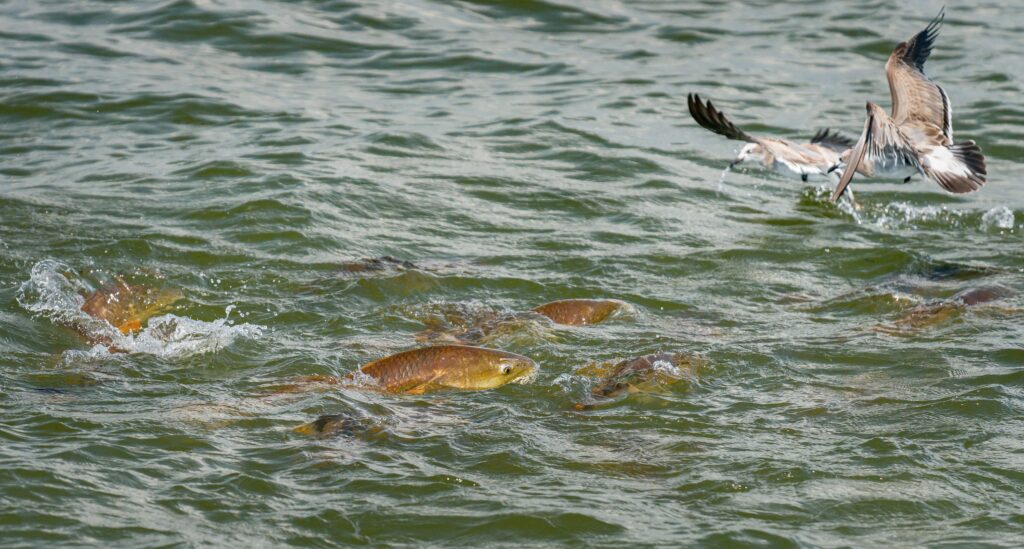
Photo: David Mangum

Louisiana Moves to Allow Near-Shore Industrial Fishing

Two weeks ago, under industry pressure, the Louisiana Wildlife and Fisheries Commission (LWFC) voted to proceed with a Notice of Intent to reduce an existing half-mile buffer zone preventing industrial menhaden fishing near Louisiana’s coast to just a quarter-mile in most locations. This decision disregarded data that show the half-mile buffer is preventing fish kills that waste hundreds of thousands of menhaden (more commonly called “pogies” in the Gulf) as well as thousands of redfish and other pogy predators annually. It also largely ignored a recent study that showed industry bycatch of redfish and other important gamefish species is more likely in shallower, near-shore waters. 

Below are menhaden reduction industry claims we’ve seen in the media and/or in public meetings recently that require clarification. 

Industry Propaganda in the Gulf

Industry Claim (from LWFC meeting on Nov. 6): “The current buffer zone is cutting profits and workers’ jobs are at risk. Our fleet can’t catch enough fish elsewhere besides the area within a half-mile from shore to make enough money to maintain our financial performance.

This claim is blatantly false, according to NOAA Fisheries data. 

  • The menhaden industry has not provided concrete economic evidence for why the half-mile buffers should be reduced. They caught essentially the same number of fish in 2024 and 2025 while the buffers were in place as they did in 2020 and 2021 without the buffers. Further, since 2024, the value of their menhaden landings has actually increased by $60 million. And, in 2025 before even counting October’s harvest, the industry has already exceeded its 2024 catch by 93 million pounds.  
  • The industry is not only clearly catching plenty of fish, since they weren’t complaining about having to cut jobs in 2020 and 2021, they are also increasing their total revenue as the value of each fish caught is higher than ever.  
  • The industry is allowed to fish anywhere else besides inside the small buffer zone within a half-mile from shore (and a wider buffer of 1-3-miles in a few small areas off public beaches). Not only do they have full access to every other expanse of water in the Gulf and most areas inside Breton and Chandeleur Sounds besides this tiny, fragile nearshore area, but they have no limit to how many fish they can catch each year. Logic would dictate that they should be able to catch plenty of fish elsewhere, and that implying that the strip of area between ¼ and ½ mile from shore will make or break their financial performance is a sign of greed rather than need. 

Industry Claim: “The results of a 2024 bycatch study funded by Louisiana ‘reaffirm what decades of science have consistently shown: Louisiana’s Gulf menhaden fishery is sustainable, selective, and not a threat to red drum populations.’” 

This claim is short-sighted. 

  • While the industry catches fewer non-target species than the maximum legal bycatch rate of 5 percent by weight, they are still catching more than 146 million fish as bycatch annually, according to the 2024 data, including more than 30,000 redfish (22,000 of which are spawning size, which is illegal for all Louisiana anglers).  
  • In the areas where industry wants to roll back the buffers, redfish bycatch is highest during the spawning season from August-October, with up to 50 percent of the female redfish caught as bycatch actively spawning. The loss of redfish spawning potential to the state with even less protection in those areas could be very detrimental to overall redfish numbers as Louisiana tries to increase the redfish populations coast-wide.   
  • In addition, the pogy industry kills  240,000-plus speckled trout , 81 million croaker, 25 million white trout, and 12 million spot each year. These are species not just sought by recreational anglers but also forage species that Louisiana predators rely on. So, the menhaden industry not only impacts the menhaden population itself, but populations of many other forage species critical to the ecosystem.  

Industry Claim: “The fishery harvests less than 2 percent of the total Gulf menhaden biomass – helping to maintain ecological balance while preserving a key food source for marine predators.” 

This claim does not tell the full story. 

  • This assertion misrepresents what “total biomass” actually means and how fishing impacts the menhaden population. This claim is relevant for all ages of menhaden — from juveniles to spawning-capable adults — but the industry targets adult fish. If you consider how much of the spawning stock is removed each year, rather than total biomass, it becomes clear that the industry harvests a much higher percentage of the adult menhaden population.  
  • In fact, based on the 2024 Gulf menhaden stock assessment, between 2013-2023 the industry removed between 12-27 percent of the age-1+ biomass, and between 36-70 percent of the age-2+ biomass. Gulf menhaden don’t fully mature for two years, but nearly a quarter of the annual catch also includes fish that have escaped the marsh nursery grounds but have not yet spawned.  Also, 70 percent of the harvest for the entire Gulf comes from Louisiana state waters. That level of localized depletion has not been studied to analyze its effects.   
  • Comparing menhaden harvest to total biomass including fish less than one year old underestimates the pressure the fishery puts on the harvestable stock. This downplays the true ecological impact of the fishery because it ignores age structure, recruitment, and the proportion of adult fish removed from the population each year. 

Next Steps 

We know fisheries science and management definitions, concepts, and outcomes can be hard for anyone to understand, making it difficult to determine the best decisions for fisheries we care about. We encourage you to reach out to TRCP if any fisheries jargon ever needs to be better explained to help protect menhaden and the sportfish that depend on them.   

Stay tuned for information about how you can weigh in on upcoming menhaden management decisions to shape where the fishery is headed.  Learn more about these small fish with a mighty purpose by visiting TRCP’s Forage Fish Recovery Page

Banner image courtesy David Mangum

by:

posted in:

November 19, 2025

New Report Shows Conservation Is a High-Return Investment for Communities, Jobs, and Growth

Investments to conserve, restore, and manage fish and wildlife pump billions into the economy – fueling jobs, powering the $1.1 trillion outdoor recreation industry, and rivaling major U.S. sectors. 

A new report titled, “Conservation Economy in America: A Snapshot of Total Fish and Wildlife-Associated Direct Investments and Economic Contributions,” reveals that fish and wildlife conservation generates substantial economic benefits. Federal, state, local, and nonprofit contributions combined contributed $115.8 billion in total economic activity and supported over 575,000 jobs nationwide. Leading conservation organizations across the country applauded the findings, underscoring the report’s importance for America’s economy, communities, and natural resources. 

“Conservation is an investment in America’s future and the bedrock of economic growth in communities nationwide,” said Joel Pedersen, president and CEO of the Theodore Roosevelt Conservation Partnership. “This report makes clear that the principles of stewardship and collaboration that built our nation’s conservation legacy continue to drive prosperity today. By supporting proven programs that restore habitat, enhance resilience, and expand access, Congress and the Administration can deliver lasting returns for people, wildlife, and local economies alike.” 

The report finds that $55.3 billion in direct spending on conservation – including habitat restoration, fish and wildlife management, and expanded public access – forms the foundation of the nation’s $1.1 trillion outdoor recreation economy. These conservation investments generate powerful economic returns, adding $76.6 billion to the U.S. Gross Domestic Product (GDP) and $16.3 billion in tax revenues for state, local, and federal governments. Simply put, the outdoor recreation economy doesn’t happen without conservation – its contributions are the bedrock upon which all outdoor recreation depends. 

“Hunting and fishing alone contribute nearly $400 billion annually to the United States economy, and sound financial investments into conservation are the backbone of our uniquely American sporting traditions and this important sector of the economy,” said Congressional Sportsmen’s Foundation President and CEO Jeff Crane. “Investments into conservation not only bolster fish, wildlife, and their habitats, but they also strengthen hunting and fishing opportunities for sportsmen and women across the nation, a win-win for our economy and our natural resources.”    

The federal government was the leading source of conservation investments, accounting for approximately 48% of all spending. Its share, however, has been declining, even as state and local governments now provide 45% of spending – reflecting a shrinking portion of federal contributions to total conservation funding. 

Together, these investments generated tax revenues on par with the video game industry – underscoring conservation’s powerful return for communities and the economy alike, while simultaneously preserving biodiversity and strengthening long-term growth. 

Read the full report HERE

What They’re Saying 

“This report is a crystal-clear illustration that conservation investments stimulate the economy, from Wall Street to Main Street,” explained Marilyn Vetter, President & CEO of Pheasants Forever and Quail Forever. “These numbers tell the story of the conservation industry’s exponential effectiveness at turning each dollar into an economic ripple large enough to amplify our nation’s GDP. Just as important are the on-the-ground dividends of these investments, the habitat, wildlife, and water that benefit us all—hunters, anglers, families, and communities.” 

“Theodore Roosevelt once proclaimed, ‘There can be no greater issue than that of conservation in this country,” said Gray N. Thornton, president and CEO of the Wild Sheep Foundation. “This captures the essence of Roosevelt’s commitment to conservation, emphasizing both the environmental challenges of his time and the timeless relevance of his vision. He recognized that human activities threatened natural resources, and he advocated for their responsible management to ensure that future generations could enjoy the benefits of nature. Today, as the report highlights, conservation not only serves ecological purposes but also holds significant economic value. The sustainable use of natural resources can support economies while preserving the environment, reflecting Roosevelt’s original intent to protect wild lands and wildlife for the enjoyment of all. This dual focus on ecological integrity and economic prosperity underlines the importance of effective conservation efforts in contemporary society.” 

“For the many Americans who have experienced the life-changing power of the outdoors, the conservation of our country’s wildlife and wild places is self-evidently one of the greatest aspects of our nation,” said Jason Burckhalter, National Wild Turkey Federation co-CEO. “This report emphasizes how conservation efforts bolster our beloved traditions and enrich our experiences outside and it illustrates how our conservation efforts create a powerful engine for our nation’s economy. It is imperative that our elected officials see both the importance of investing in conservation, from our vital natural resources to our nation’s economy. We are excited to collaboratively share the insights from the new report with our conservation partners and make meaningful impacts for future generations.”   

“When we save wildlife, we save ourselves. This important report affirms how wildlife conservation not only helps people thrive, but also grows local economies and creates jobs in communities across the country,” said Collin O’Mara, president and CEO of the National Wildlife Federation. “This report is a clarion call for Congress and the White House that investing dedicated funding for state, Tribal, and territorial wildlife conservation will yield immense returns for taxpayers and future generations alike.” 

“America’s strong conservation economy is a testament to the contributions from hunters, anglers, and outdoorsmen and women across the country,” said Ducks Unlimited CEO Adam Putnam. “This report highlights what we’ve known for years – supporting the conservation of wildlife habitat is an incredible return on investment for our communities. With every Duck Stamp sold, every hunting or fishing license purchased, and every outfitter patronized, sportsmen and women are doing their part to support America’s natural places and rural economies, and we hope lawmakers see the immense value in strengthening these investments at all levels of government.” 

“The recreation economy remains a foundational driver of caring for the health and productivity of our family forests,” said Rita Hite, president & CEO of the American Forest Foundation. “This report highlights both the importance and meaningful impact of public and private funding in our woodlands. When we invest in family lands through recreation, we are investing in clean air and water, more biodiversity, improved wildlife habitat, and bolstering rural economies.” 

“Conservation is a core American value,” said Desiree Sorenson-Groves, President and CEO of the National Wildlife Refuge Association. “As a nation, we value our public lands and shared wildlife heritage as a tenant of who we are as a people and this report shows that our shared investment in conservation isn’t just a nice thing to do, it is an essential economic driver for Americans. Conservation paves the way for the activation of the natural resource economy in all parts of our nation from rural communities to urban cities and this report highlights how investments pay dividends now and into the future.” 

“Fish and wildlife are among our nation’s most valuable resources, along with clean air, water, healthy forests and lands that support all of us,” said Paul Johansen, Chief of the Wildlife Resources Section of the West Virginia Division of Natural Resources and President of the Association of Fish & Wildlife Agencies. “State agencies have a primary responsibility for conserving our treasured natural resources. This report clearly illustrates that states, in collaboration with their federal, tribal, and conservation partners, deliver fish and wildlife conservation to our citizens with an impressive return on investment that generates positive impacts felt throughout the larger economy.”  

“When we discuss funding for conservation programs, it’s important that we think of these programs as investments for the future – the future of clean water, clean air, outdoor recreation, and abundant fish and wildlife. However, this report confirms that these conservation programs are also literal financial investments that help everyone’s bottom line, beyond the outdoor recreation industry and everyone it employs, directly or indirectly,” said Jeff Kopaska, Executive Director of the American Fisheries Society. “We saw this with the establishment of the Sport Fish Restoration Program 75 years ago. A small percentage of spending on fishing gear and boating fuel is directed towards fisheries restoration, research, and conservation, creating a self-sustaining cycle that builds up the sport fishing industry, along with providing more recreational opportunities and of course, benefitting our fish populations.” 

by:

posted in:

November 13, 2025

Fact or Fiction: Debunking Atlantic Menhaden Industry’s Deceptive Claims

The menhaden reduction industry has frequently and publicly tried to justify its harvest levels, destructive practices, and fishery management decisions in its favor; here TRCP breaks down its misleading claims

The menhaden reduction industry should by all counts be very happy with the outcome of recent decisions affecting fisheries management on the Atlantic and Gulf coasts – with science-based cuts to catch quota being ignored and buffers that protect nearshore habitat and reduce bycatch slated for reduction. Meanwhile, anglers and conservation advocates continue to scratch and shake their heads at decisions guided by politics much more than science. After all, nutrient-dense menhaden play a central role in marine food webs as baitfish providing an essential food source for economically important sportfish like striped bass, redfish, tarpon, and bluefin tuna, as well as predators like whales and ospreys.

Despite these discouraging outcomes, the menhaden industry is seeking public sympathy. In interviews with the media and in public hearings, its representatives say they have been and will continue to suffer financially, that they could face job cuts, and that they are committed to sustainable fisheries and healthy ecosystems. But is any of that actually true?

As recreational anglers and conservationists, it’s important that we all stay well informed of the facts when engaging in the ongoing debate around menhaden management in the Atlantic and Gulf. Understanding complex fisheries management concepts is also important even when just assessing menhaden reduction industry-generated talking points in the “news” (which often isn’t news at all, as 2025 has seen a landslide of paid placements, and claims unvetted by journalists, that appear on well-known news websites with only small disclaimers attached).

In this blog, we’ll focus on misinformation peddled by the industry on the Atlantic front. Next week, we’ll offer a similar post that focuses on the Gulf.

Chris Crippen/Virginia Institute of Marine Science

Recent Vote on Atlantic Menhaden Ignores Science

As we reported two weeks ago, the Menhaden Management Board of the Atlantic States Marine Fisheries Commission (ASMFC) failed to cut the 2026 Atlantic menhaden quota by nearly enough to acknowledge the latest science showing that the menhaden population is far lower than previously estimated. Instead of the more than 50 percent cut necessary to rebuild the Atlantic striped bass population and support menhaden’s ecosystem role, only a 20 percent quota cut was made – which will not lower coastwide harvest for the menhaden reduction industry at all, based on 2024 commercial landings.

Below are a few major claims that we’ve seen in the media recently that deserve a serious second look.

Industry Propaganda in the Atlantic

Industry Claim: “Maintaining the status quo or making, at most, a modest, precautionary trim is consistent with risk policy; in particular, a reduction on the order of 10% eliminates overfishing risk in 2026 and remains extremely low if carried forward, so deeper cuts are not supported by the risk framework.”

This claim doesn’t tell the real story.

  • Within the Atlantic menhaden management framework, the ASMFC uses an ecosystem-based “fishing mortality threshold” to define whether menhaden are undergoing overfishing or not. There is a range of fishing pressure for menhaden between an ecosystem-based “target” and threshold which the Menhaden Management Board has the ability to choose from, each option representing various levels of risk for overfishing. The ecosystem-based target is just what you’d imagine, a target or best-case scenario for fishing mortality, that won’t remove too many fish from the water. The threshold, on the other hand, represents the highest level of fishing mortality that the Board can allow before the fishery is considered to be undergoing “overfishing,” thus warranting corrective action.
  • A fishing mortality rate below the ecosystem-based target would be the most precautionary scenario, where we can be pretty sure, based on the science available, that we have enough menhaden in the water to feed striped bass and other predators. ASMFC assumed we were at this level based on the previous science, but with this new stock assessment, realized that they erred in their estimations and that fishing mortality was/is above the target.
  • A fishing rate above the target, but below the threshold, is a riskier scenario. This is where there are still menhaden being left in the water for predators, but not enough to support striped bass if they were at a rebuilt biomass. This level is where we have previously been fishing at, based on the new stock assessment update, and where the 2026 fishing level will be as well. So, not enough for striped bass if they were at their full biomass target.
  • Only a fishing rate above the threshold is considered “overfishing,” and would warrant Board action to decrease menhaden fishing pressure. Even keeping the same coastwide quota that we’ve had for the past 3 years in 2026 would present essentially zero risk of crossing the threshold, so the Board is not worried about overfishing from a technical standpoint. Where the rubber meets the road is that we now know that even with the recent 20 percent quota decrease, more menhaden will be taken out of the water than should be left to support striped bass populations as they rebuild over the next few years.
  • If menhaden harvest ever reaches its fishing mortality threshold, striped bass numbers will fall even more, even if striped bass themselves continue to be fished at or below their own mortality target. While this scenario is not likely with a 20 percent quota cut, which is what the industry touts, the contradiction of minimal conservation measures made for menhaden – a food source critical for striped bass – with the extreme striped bass management measures anglers have made sacrifices for, for years now, is alarming.

Industry Claim: “There will likely be some operational adjustments required at our Reedville [Virginia menhaden processing and reduction fleet base] facility to comply with a 20 percent harvest reduction.”

This claim is conspicuously misleading.

  • Omega Protein/Ocean Harvesters will not feel the hit of this quota reduction, while other Atlantic states with menhaden bait fisheries will. The move to reduce the coastwide quota by 20 percent was not based on science or the ASMFC’s ecosystem-based framework, but was a number originally put forward by the ASMFC’s Virginia delegation, because it would not materially impact the Commonwealth’s landings.
  • The reality is the reduction industry has not been able to meet their full quota in years, and is catching around 80 percent of their current allocation (in other words, 20 percent less than the current quota, or the full amount of the new quota set for 2026). Likely, the only reason Virginia representatives were against the measure in the final vote was because it was a one-year decision, rather than one that would have given the reduction industry three years of fishing at this set quota.
  • So the new quota will not significantly cut coastwide harvest or Virginia’s harvest, but where the cuts will actually be felt is by the states with active bait fisheries in the north, such as in Maine, who have to settle for the leftovers after the reduction industry (one company) gets nearly 70 precent of the allowable menhaden catch.
  • The industry frequently makes claims that any impacts to their ability to catch menhaden will cost jobs. But what wasn’t taken into consideration by the Board was that striped bass anglers have taken significant cuts to their striper access for many years now – which hurts jobs in the charter fishing, bait/tackle, tourism, and boating industries. Those sacrifices seem in vain now, since no matter what happens with striped bass catch, we aren’t leaving enough forage in the water for stripers to reach their biomass target by 2029.

Industry Claim: “We support moving forward with targeted new Bay science to guide any future Chesapeake Bay-specific decisions, so that upcoming choices are grounded in robust, transparent analysis.”

This claim is hypocritical on its face.

  • For the past three years, Omega Protein/Ocean Harvesters has actively lobbied against efforts in Virginia to fund science projects that would guide menhaden management in the Bay. These are projects that they were involved in developing with other stakeholder groups and state scientists from the very beginning.
  • Bay-specific menhaden management should be grounded in science and transparency, but the industry is clearly only interested in biased science to benefit their own agenda, because not so coincidentally, just before this past ASMFC meeting, the industry’s self-funded research group announced its own project to determine the scientific basis for their Bay fishing cap, rather than rely on an publicly funded study. Sound fishy to you?
  • The 2025 stock assessment update showed very clearly that cuts to the coastwide menhaden quota were necessary moving forward to maintain the integrity of the ecosystem-based framework that the industry claims it supports. In 2022, when the science then indicated a quota increase was possible, the industry was fully on board with using the science to their advantage to be able to catch more fish. Now, when the science suggests a major quota reduction is in order, the industry decided it didn’t want to follow the science anymore.

Next Steps

Fisheries science and management definitions, concepts, and outcomes can be hard for anyone to understand. That makes it that much more difficult to determine if decisions that can affect fisheries we care about are good ones, or bad. We hope this breakdown of the facts has been helpful and encourage you to reach out to TRCP if there’s anything else we need to focus on to best arm you with the knowledge necessary to help protect menhaden and the sportfish you care about.  

Stay tuned for a similar blog next week on misinformation coming from the Gulf menhaden industry, and for information about how you can weigh in on recent menhaden management decisions and shape where the fishery is headed.

Banner image courtesy Joanna Steidle

by:

posted in:

Deer Season – Hunting & CWD: A Hunting Journal Found and New Hunters in the Making

From handwritten memories to new milestones afield – TRCP’s Ryan Chapin reflects on passing on the hunt while staying informed and committed to good CWD stewardship in Montana.

In Montana, the Youth-Only Deer Season marks the start of big game hunting for many families. Public schools close for teacher-in-service days, giving kids ages 10 to 15 the first crack at harvesting deer with a firearm. This camp has become a rite of passage for our kids and some of their friends, and a tradition that we all look forward to. 

While preparing for this year’s camp, I unexpectedly found a hunting journal that I started years ago when I was a youth hunter myself in my home state of Ohio.  At the garage work bench, I turned on a light and opened the binder’s Velcro clasp and flipped through my handwritten notes and sketches.  

 I read one of the entries: “September 5, 1994 – Tomorrow Dad, Austin and I will set a stand at Bickley’s in the corner near the apple trees…” 

These memories reminded me of how deeply rooted this tradition is for me and how pleased I am now to be passing it along to our kids and their friends.  

Using the same pencil that I hadn’t touched for over 31 years, I wrote:  

“October 14, 2025 – Tomorrow, my daughter Ella, her friend Addie and I will join our friends in setting the annual Youth Deer Hunting camp on Rock Creek…”  

While setting up camp the next day, I thought of how much of hunting is the same as when I was a kid; lanterns still whisper, and wood stoves still cast warm flickers of light.  I also thought about how hunting has changed since my childhood. Today’s hunters come equipped with range finders, digital phone maps, boots that are actually waterproof, and CWD sample kits from local game and fish offices. 

Still, the hum of the modern hunting season carries a new awareness. Chronic wasting disease looms in conversations and decisions alike, reminding us that stewardship means more than just taking a clean shot – it means staying informed, testing our harvests, and helping safeguard the future of the hunt. 

After camp was set, we planned out the hunt while roasting hot dogs over an open fire. Over the next several days, each group would take a different location to maximize the girl’s chances of success.  Our group hummed with excitement, and I thought about how nice it was to be back here along the creek among friends, family and the towering ponderosa pine.  

In the early morning dark, Addie, Ella and I went out on the big ridge to where the cliff overlooks the creek bottom.  Addie, who’s joined the camp for years as a non-hunting companion, just recently took hunter’s safety and honed her shooting skills with us at the range.  Ella and I admired her determination, her sharp eye for spotting animals, and her interest in becoming a hunter; we were keen on helping her get her first deer.  We settled into the rocks and waited for the sun to rise. 

Not long after shooting light, Addie tapped Ella on the shoulder and tugged on my coat’s hood to get our attention.  

“There are two deer below us in the rocks by the river,” Addie whispered while pointing straight ahead and down.  

Ella nor I could see the deer until their tails flickered white and moved away before a shot could be set up. We were impressed with Addie’s keen eye; while also a bit embarrassed that we couldn’t see the deer ourselves.  

Over the next hour, Addie followed the same routine two more times, seeing and pointing out deer unseen by Ella or me. I rubbed my eyes, gave Ella a concerned look and whispered to Addie.  

“The next deer you see, just get it in your scope fast and don’t worry about showing us!” 

Before we knew it Addie was at it again, but this time she pivoted her body and the rifle to the left.  Immediately we saw the deer coming our way along the creek bottom.  Ella ranged the deer at 160 yards, and I helped Addie switch the rifle’s safety to fire and increase the magnification of the scope. Addie focused in and her shot was good.  The deer collapsed on the spot. She rolled away from the rifle and grinned.  Ella was there with high-fives and praise for a job well done.  

We gathered our gear and walked down off the cliff following the water to where the dead deer lay in the tall grass.  Addie punched her tag, and we got out knives. We could see the other hunters coming our way as they must have heard the shot.   

Addie asked, “Ryan, do we have to leave the brains and spine behind like we did in Eastern Montana?” Referring to a guideline that applied at one time to certain hunting districts in Montana.    

“Not here Addie, we will drag the deer out whole and dispose of the carcass.  Also, we will take a lymph node sample and make sure your deer tests negative for CWD before cooking burgers and steaks, how does that sound?”  

Addie nodded and explained that she learned about carcass disposal in her recent hunter’s safety class.  

The rest of the girls arrived and rallied around her. They helped with the field dressing, offered congratulations, and worked together to drag the deer out to the road. It was satisfying to see young hunters supporting one another and seeing in real time one of human’s oldest skills being passed to another generation.   

During the rest of our time at deer camp, Ella and Ava each also harvested deer and were supported by their friends with the same encouragement and camaraderie.  As we packed up and headed home, I was pleased with how my relationship with hunting has evolved. From scribbling notes in my first hunting journal to watching a new generation carry the tradition forward.  As we left camp, I felt a quiet responsibility settle in; the kind that comes with knowing our tradition is alive, and that it’s ours to pass on. 

As we unpacked gear back home, I thought about how much I’ve learned since those early journal entries – less about taking deer and more about taking care. Each season, I study the Montana Fish, Wildlife & Parks hunting regulations booklet and CWD updates before heading out, check which units require sampling, and make sure our family has fresh sample kits and knows the rules for carcass transport and disposal. On the lands we hunt – from the river bottoms to the timbered ridges – I’ve come to see these steps not as burdens, but as part of the hunt itself: another way to respect the resource and the places that give us so much. Staying informed, testing our deer, and cleaning our gear are small acts that help ensure these same camps, lanterns, and early mornings remain part of the next generation’s hunting stories. 

When the season ends and the freezers are (hopefully) full, I’ll take a quiet moment to look back on what we learned about the deer, the land, and ourselves, and just maybe, I’ll keep that old journal close by and start writing in it again.  

Deer Season – Hunting and CWD.

This new TRCP series shares the personal deer hunting stories of three staff members while exploring the practices aimed at addressing the spread of chronic wasting disease. This season, we invite you to follow along and take part in preserving what we love most about deer hunting. 

As deer seasons open across the country, hunters are packing gear, checking maps, and preparing for the moments that define another fall outdoors. But today’s deer hunters face new challenges – chief among them, the spread of Chronic Wasting Disease (CWD), a 100-percent fatal neurodegenerative wildlife disease that affects members of the deer family. While more and more hunters are finding CWD in their backyards, it remains a source of confusion for many.  

From pre-season prep and regulation changes to lessons learned in the woods and around deer camp, Deer Season – Hunting and CWD will show how everyday hunters are part of the solution. Along the way, you’ll find tips, resources, and reflections that tie together our love of the hunt with our shared responsibility to keep deer herds healthy for future generations. 

Learn more about Chronic Wasting Disease here.

HOW YOU CAN HELP

TRCP has partnered with Afuera Coffee Co. to further our commitment to conservation. $4 from each bag is donated to the TRCP, to help continue our efforts of safeguarding critical habitats, productive hunting grounds, and favorite fishing holes for future generations.

Learn More

You have Successfully Subscribed!

You have Successfully Subscribed!

You have Successfully Subscribed!

You have Successfully Subscribed!