September 18, 2025

Hunters and Anglers Cheer House Introduction of MAP Roads Act  

Bill would direct Department of Transportation to establish grant program to fund the digitization of county public roads

The Theodore Roosevelt Conservation Partnership joins hunters, anglers, and all who drive rural, county roads in cheering House introduction of the Modernizing Access to Public Roads Act.

The bipartisan legislation is sponsored by Representative Blake Moore (R-Utah) and cosponsored by Representative Val Hoyle (D-Ore.), Representative Jeff Hurd (R-Colo.), and Representative Susie Lee (D-Nev.). 

“The lack of publicly accessible and accurate county road map information is a key barrier for hunters and anglers trying to access public lands,” said Joel Pedersen, president and CEO of the Theodore Roosevelt Conservation Partnership. “The bipartisan MAP Roads Act will provide funding to address these mapping shortfalls and improve public access, resulting in reduced confusion for hunters and anglers trying to navigate rural road systems across America.”

The MAP Roads Act builds on the success of the MAPLand Act, MAPWaters Act, and MAPOceans Act by establishing a $20 million, 5-year pilot grant program through the U.S. Department of Transportation to:

⦁ Fund county road digitization by converting paper or outdated formats into standardized geospatial datasets.

⦁ Create publicly accessible statewide road data repositories that distinguish public and private roads, are compatible with third-party mapping platforms, and are updated annually.

⦁ Provide funds to support local capacity toward county subgrants, personnel training, or hiring contractors for data conversion.

The clarity and accessibility to this information for both the public and local municipalities would improve rural commerce, public safety, navigation, and access to public lands so more Americans can confidently access and enjoy their public roadways and the adventures beyond. The MAP Roads Act would not create any new road authority, or alter any legal status, ownership, or jurisdiction of roads.

“We appreciate Congressman Moore’s introduction of the Modernizing Access to Public Roads Act,” said Judy Camuso, commissioner of the Maine Department of Inland Fisheries and Wildlife and president of the Association of Fish and Wildlife Agencies. “This legislation affords the opportunity for states and local governments to utilize technology to improve road access data that will ultimately help improve public access for our hunters, anglers, and outdoor recreationalists.”

“Too often, outdoor recreationists are left guessing whether a rural road is public or private because county road records have not kept pace with modern navigation technology,” said Laura Orvidas, CEO of onX. “This uncertainty can restrict recreational access to public places and can cause conflicts between private landowners and the public. The MAP Roads Act will accelerate the modernization of these records, giving people the confidence to know where they can travel to reach public land. Not only will it expand recreational access, but it will also streamline county operations, all while preserving local authority over road networks.”

“In an era where mobile apps and GPS are essential for navigating vast public lands to reach remote hunting grounds, accurate and up-to-date county road data is critical,” said Kurt Dyroff, Co-CEO of the National Wild Turkey Federation. “The MAP Roads Act will reduce inadvertent trespass risks, enhance safety during hunts, and open safer, more reliable access to our nation’s public hunting opportunities.”

“Accurate and readily available maps are essential for ensuring access to our nation’s public lands and waters,” said Kaden McArthur, Congressional Affairs Director for Trout Unlimited. “We thank Representative Blake Moore for his leadership on the MAP Roads Act which would make it easier to find reliable routes to rivers and streams by bringing outdated road maps into the digital age. This legislation would allow anglers to spend more time on the water and less time worrying about how to get there.”

Learn more about TRCP’s commitment to public access HERE.
Do you have any thoughts on this post?

XHTML: You can use these tags: <a href="" title=""> <abbr title=""> <acronym title=""> <b> <blockquote cite=""> <cite> <code> <del datetime=""> <em> <i> <q cite=""> <s> <strike> <strong>

Comments must be under 1000 characters.

September 12, 2025

Weigh in on Behalf of America’s Backcountry

Hunters and anglers can help shape the future of our national forests

Anyone who has spent time hunting and fishing on our national forests knows that success often depends on putting some distance between yourself and roads. Roadless areas—casually called the backcountry—are essential to America’s sporting traditions and wildlife management.

These roadless landscapes provide secure refuge for elk, mule deer, and other big game species, ensuring healthy herds and sustaining increasingly rare over-the-counter hunting opportunities. State wildlife agencies have long emphasized that blocks of secure habitat are critical for effective herd management and for preventing displacement of wildlife onto private lands.

For anglers, roadless areas conserve cold, clean headwaters that sustain wild trout and salmon, and roughly 70 percent of roadless areas contain habitat for native fish.

These qualities are why the sporting community values roadless areas and sees them as a crucial part of the future of hunting and fishing in America.

The Proposal to Rescind the Roadless Rule

On August 29, the U.S. Department of Agriculture published a notice proposing to rescind the 2001 Roadless Area Conservation Rule—a long-standing policy designed to maintain these backcountry values. The public comment period is open through September 19.

A primary argument for rescission is to allow more flexibility for wildfire suppression and forest management. Hunters and anglers understand this does not have to be an either/or choice. We can support proactive management to reduce wildfire risk and improve forest health while maintaining safeguards that are critical for fish, wildlife, and our sporting traditions.

A Balanced Path Forward

Hunters and anglers support a middle ground approach to managing roadless areas. This approach respects backcountry values and provides flexibility where it’s needed. That means:

  • Conserving core backcountry habitat for fish and wildlife while allowing thinning, prescribed burning, and restoration projects to protect communities and improve habitat.
  • Limiting costly new road construction so that scarce agency funding can go toward maintaining the 370,000 miles of existing national forest roads that already provide access for hunters, anglers, and local economies.
  • Accommodating multiple uses, including livestock grazing and motorized and non-motorized recreation.

The Roadless Rule was designed to strike this balance. Rather than scrapping it altogether, the USDA should work with hunters, anglers, and other stakeholders to adapt and improve the rule to ensure it remains durable, practical, and true to the values we share. We have seen this approach work before with the Idaho and Colorado Roadless Rules, and we can apply that success to the rest of the National Forest System.

Take Action

This comment period is our chance to ensure that the future of America’s backcountry reflects hunting and fishing values. By speaking up, we can help secure lasting hunting and fishing opportunities for future generations of sportsmen and women.

Hunters and anglers can make a difference by commenting before September 19.

Here are some important talking points to include in your comments:

  • Roadless areas are critical to America’s sporting traditions. They provide secure habitat for elk, deer, and other big game, and conserve headwaters that sustain native trout and salmon. These landscapes ensure that future generations of hunters and anglers will have the same opportunities we enjoy today.
  • Hunters and anglers know that flexibility can be added to the rule to reduce wildfire risk while also improving forest health and maintaining conservation safeguards that are critical for fish, wildlife, and sporting traditions.
  • The Forest Service should work with hunters, anglers, and other stakeholders to adapt and improve the rule so it remains durable, practical, and true to the values we share.
  • A balanced approach will ensure our forests remain healthy, our communities are safer, and our sporting traditions persist.

MAPOceans Act Passes Senate

New legislation would modernize accessibility to saltwater recreational fishing regulations and marine waters navigation information 

Saltwater anglers, hunters, and marine recreationists joined the Theodore Roosevelt Conservation Partnership in cheering Senate passage of the Modernizing Access to Our Public Oceans Act this week by unanimous consent. The MAPOceans Act will direct the standardization, consolidation, and digitization of boating and recreational fishing information for federally managed marine waters and federal fisheries administered by the National Oceanic and Atmospheric Administration. 

The bipartisan legislation was introduced by U.S. Senators Ted Cruz (R-Texas) and Angus King (I-Maine). 

“TRCP joins America’s sportsmen and sportswomen in thanking Senators Cruz and King for bringing forth this bipartisan, access-oriented legislation, and greatly appreciates the broader Senate support for its passage,” said Joel Pedersen, president and CEO of the Theodore Roosevelt Conservation Partnership. “The MAPOceans Act will help simplify fishing and boating experiences to enhance recreation opportunities, while expanding access by making the necessary information for safe, legal saltwater fishing more readily available through digital technology.” 

The MAPOceans Act builds on the success of the MAPLand Act, passed in 2022, and the MAPWaters Act, which passed out of the House of Representatives in January 2025, by directing NOAA to digitize navigation and recreational use rules for marine waters and federal fisheries, and to make those resources readily available to the public. The hundreds of thousands of offshore ocean miles and numerous saltwater fish species regulated by NOAA present enormous recreational opportunities where restrictions are difficult to access and constantly changing. MAPOceans directs the federal agency to compile those rules in digital form so they can be integrated into GPS units and smartphone applications that are popular with boaters and anglers, making that information available to the public in real time. 

“The MAPOceans Act consolidates and makes existing spatial information more accessible, empowering anglers to better understand and safely enjoy our marine waters,” said Glenn Hughes, president of the American Sportfishing Association. “We thank the Senate for passing this bipartisan bill and look forward to its continued progress.” 

“We applaud Senator Cruz and Congressional Sportsmen’s Caucus Co-Chair Senator King for their leadership in passing the MAPOceans Act out of the Senate,” said Chris Horton, senior director of fisheries policy for the Congressional Sportsmen’s Foundation. “This much needed, bipartisan legislation will finally remove the uncertainty about where we can fish and with what gear that can often create barriers for angler participation on our coastal waters.”    

“At the Marine Retailers Association of the Americas, we recognize the immense value our coastal regions provide—not only as vital ecosystems but also as hubs for recreation that drive local economies and support marine retailers,” said Matt Gruhn, president of the MRAA. “The MAPOceans Act represents a crucial step forward in providing standardized, accessible data about our nation’s waterways. By digitizing key information like fishing regulations and restrictions, this legislation will enhance safety and enjoyment for recreational boaters and anglers, while also supporting conservation efforts. We’re grateful to Senators King and Cruz for their leadership in championing this important initiative and their hard work to get it passed out of the Senate.” 

“Expanding access to the information anglers and boaters need to safely get out on the water will help fuel America’s $1.2 trillion outdoor recreation economy,” said Jessica Wahl Turner, president of the Outdoor Recreation Roundtable Association. “The Outdoor Recreation Roundtable appreciates Senators Cruz and King for championing the MAPOceans Act and for finding innovate ways to allow more Americans to enjoy the outdoors.” 

Learn more about TRCP’s work to improve your access to public lands and waters HERE

Photo Credit: David Mangum

August 27, 2025

TRCP Applauds DOI Action to Expand Hunt-Fish Opportunities on Public Land   

Increased opportunities will benefit hunters and anglers beginning Fall 2025    

The Theodore Roosevelt Conservation Partnership joined hunters and anglers in celebrating the announcement by the Department of the Interior to expand hunting and fishing opportunities across the National Wildlife Refuge and National Fish Hatchery Systems.   

“TRCP thanks Secretary Burgum for prioritizing expanded hunting and fishing opportunities at the Department of the Interior,” said Joel Pedersen, president and CEO of the Theodore Roosevelt Conservation Partnership. “These new opportunities will help Americans get outside to enjoy the great outdoors just in time for the fall hunting and fishing seasons.”  

The final rule for the 2025–2026 season creates 42 new hunting and sport fishing opportunities on more than 87,000 acres of public lands across 11 states. These new opportunities will be available starting September 2, 2025.    

The National Wildlife Refuge System Improvement Act of 1997 prioritizes compatible wildlife-dependent recreational use on wildlife refuges and specifically identifies hunting and fishing as priority uses. This most recent expansion will increase sporting opportunities by opening more acres and units to hunters and anglers. For hunters and anglers, this means: 

  • New Access: Inaugural hunting opportunities will be offered on public lands such as Southern Maryland Woodlands National Wildlife Refuge and the Grasslands Wildlife Management Area, and new sportfishing access will be available at North Attleboro National Fish Hatchery. 
  • Broader Alignment: Regulations are being streamlined to better match state fish and wildlife rules, helping reduce confusion and making it easier for hunters and anglers to enjoy these places. 
  • Conservation Benefits: By engaging hunters and anglers, these opportunities generate critical funding for habitat restoration, wildlife management, and local economies through license sales and excise taxes on gear and ammunition. 

The final rule will be published in the Federal Register on August 28, 2025, and is available at regulations.gov (Docket FWS-HQ-NWRS-2025-0031). Updates take effect for the 2025–2026 hunting seasons beginning September 2, 2025. 

These expanded opportunities reflect progress worth celebrating. Learn more about TRCP’s work to safeguard and improve hunting and fishing access by clicking HERE. Together, we can ensure that access, conservation, and America’s sporting traditions remain at the heart of our shared future. 

Top Photo: Josh Metten


The TRCP is your resource for all things conservation. In our weekly Roosevelt Report, you’ll receive the latest news on emerging habitat threats, legislation and proposals on the move, public land access solutions we’re spearheading, and opportunities for hunters and anglers to take action. Sign up now.

August 21, 2025

The Merits of Fly Fishing: A Conversation with Peter Kaminsky 

The author, angler, and conservation advocate shares why fly fishing continues to inspire him—and why anglers must have a voice in conservation. 

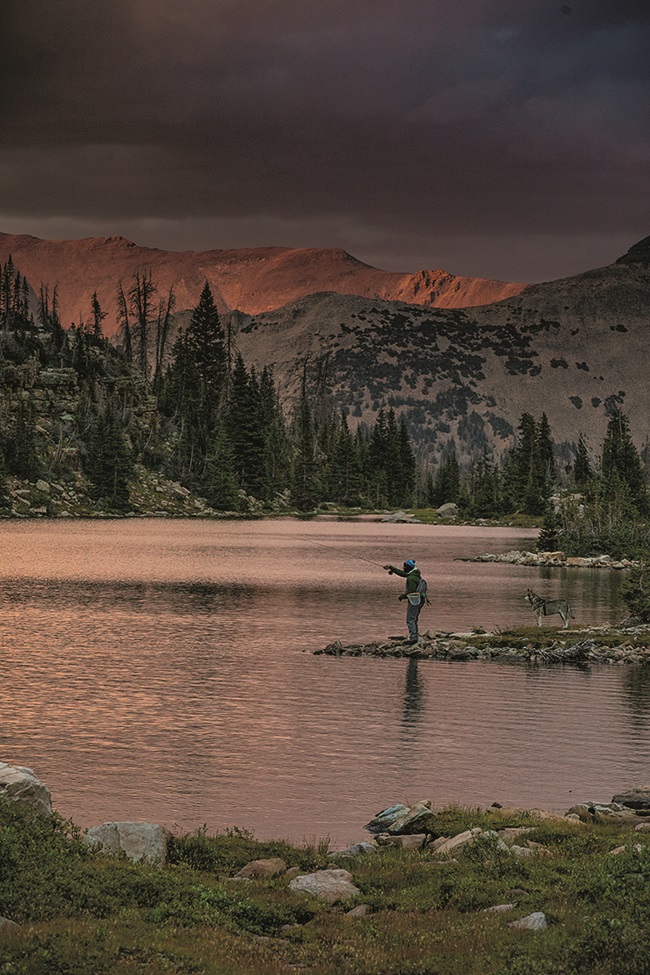
Few people can capture the magic of fly fishing like Peter Kaminsky. The celebrated author, journalist, and lifelong angler has spent decades chasing fish across the globe—and championing the waters and habitats they call home. In this exclusive TRCP conversation, Kaminsky shares the captivating story of how he fell in love with fly fishing, the ways it has shaped his life, and why anglers have a critical role to play in conservation. Whether you’re a seasoned fly fisher or just wondering if the sport might be for you, his reflections are as inspiring as they are insightful. 

For more than three decades, Kaminsky contributed to the New York Times Outdoors column and has served as a contributing editor to Field & Stream, Sports Afield, and Outdoor Life. His books—including The Moon Pulled Up an Acre of Bass and The Catch of a Lifetime—blend storytelling, personal reflections, and a deep respect for the natural world. His newest release, The Zen of Flyfishing (2025), captures the joy and meaning he’s found in the sport through essays, quotes, and stunning imagery. 

Credit: William Hereford

In our latest conversation, Kaminsky reflected on his journey into fly fishing, the restorative qualities of time on the water, and the role anglers play in sustaining healthy fisheries. He also shared some interesting history about Theodore Roosevelt’s uncle, another outdoorsman who inspired the future president’s conservation ethos. 

Credit: Jared Zissu

Finding a Calling on the Water 

Peter Kaminsky’s first encounter with fly fishing was clearly transformative. On a trip to Mexico in the 1970s, he watched veteran anglers casting in the surf and felt an instant connection—what he calls “the hour I first believed.” Back in New York, he sought instruction from legendary fly fisherman Doug Swisher and never looked back. 

Since then, fly fishing has been a grounding force in both good times and bad. “It’s the thing I return to in the rough times,” he says, describing how the sport can suspend time and bring peace. Hear his account of how during a period of personal hardship, while fishing Idaho’s Silver Creek, he found both solace and perspective: “It showed me you don’t have to feel miserable all the time – there’s a sunny side.” 

Credit: Andrew Burr

Conservation, Connection, and Responsibility 

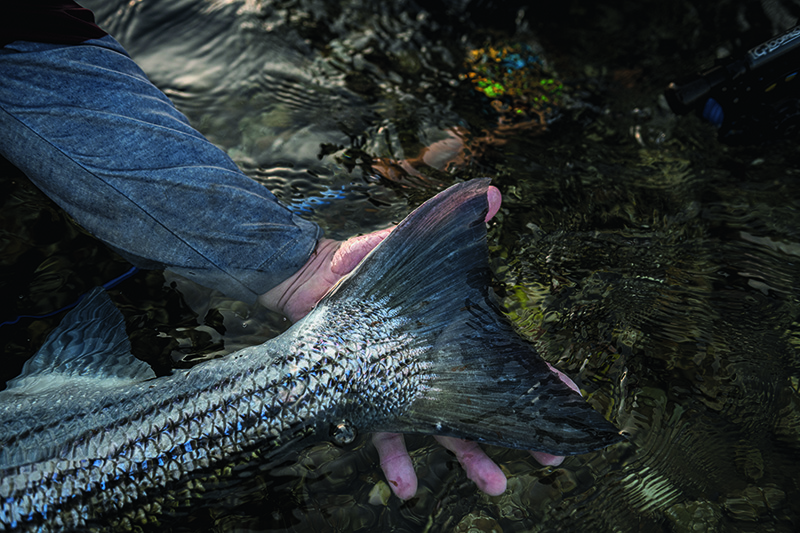
Kaminsky has fished around the world, from trout streams in the Rockies to bonefish flats in the Yucatán, but remains deeply connected to the waters near home—especially the striped bass fishery along the Atlantic Coast. He’s witnessed the boom-and-bust cycles of striper populations and warns that current challenges, from depleted menhaden stocks to degraded spawning habitat in the Chesapeake Bay, demand action. 

For him, conservation isn’t about moral superiority; it’s about ensuring the future of the resource.  And wherever you stand on the practice of catch and release fishing, you’ll want to hear his wisdom on the matter.  

“Everything gets eaten in this world,” he says. “It’s just a question of who’s eating it and when.” 

Credit: Rex Messing

Passing It On 

Kaminsky also takes inspiration from conservation history, noting the influence of Theodore Roosevelt’s uncle, Robert Barnhill Roosevelt, in shaping America’s fish and game management. He sees that legacy as a call to keep our lands and waters “green and bountiful” for the next generation. 

For those curious about fly fishing for the first time, his advice is simple: get casting lessons. “Seek out someone with the patience to teach you,” he says. “The investment will pay off.” 

Watch the full interview here

All photos are from The Zen of Flyfishing by Peter Kaminsky (2025), published by Workman Publishing, a division of Hachette Book Group.

HOW YOU CAN HELP

TRCP has partnered with Afuera Coffee Co. to further our commitment to conservation. $4 from each bag is donated to the TRCP, to help continue our efforts of safeguarding critical habitats, productive hunting grounds, and favorite fishing holes for future generations.

Learn More
Subscribe


You have Successfully Subscribed!

You have Successfully Subscribed!

You have Successfully Subscribed!

You have Successfully Subscribed!

You have Successfully Subscribed!