BLM Completes Third Round of Planning to Conserve Iconic Greater Sage Grouse
Opportunity to move beyond planning to conserve sagebrush habitat for hunters, anglers, and Western communities
Today, the Bureau of Land Management published approved resource management plans and records of decision for greater sage grouse plan amendments in California, Idaho, Montana, Nevada, North Dakota, South Dakota, Utah, and Wyoming. Approved resources management plans for Colorado and Oregon were finalized in January 2025. Together, these plans guide how millions of acres of sagebrush habitat across the West will be managed to conserve wildlife, support Western communities, and ensure quality places for hunters and anglers.
“For almost 15 years, state agencies have worked in an unprecedented collaboration with the BLM to revise management plans to conserve over 67 million acres of sagebrush habitat,”said Madeleine West, vice president of Western conservation for the Theodore Roosevelt Conservation Partnership. “We hope the completion of these plans ends the roller coaster cycle of planning so that state and federal agency resources can be spent on what is most important – species and land management to benefit the sagebrush ecosystem and Western communities that rely on it.”
This concludes the BLM’s third round of land use planning, the first of which began in 2011. Plans originally completed in 2015 were revised in 2020, and those 2020 plans were subsequently challenged in court, necessitating this latest round of revisions. As the largest manager of sage grouse habitat, it is essential that the BLM have robust land use plans that incorporate the best available science to conserve the species. But for over a decade the BLM has needed to prioritize planning over management, which fails to serve the iconic bird, other sagebrush obligate species, and the people who depend on these landscapes.
The TRCP has been on the front lines of sage grouse conservation for years. The decline of this iconic game bird of the American West is the most visible indicator that sagebrush habitat is in trouble. That matters to hunters and anglers because the sagebrush ecosystem is home to more than 350 different species of plants and animals, including such iconic game species as pronghorn and mule deer. Healthy, intact sagebrush landscapes are essential not only for sage grouse, but for resilient wildlife populations, migration corridors, and quality places to hunt and fish across the West.
For more information about the Greater Sage-grouse Land Use Plan Amendments, click HERE.
Greater Sage Grouse Land Use Planning Complete in Colorado and Oregon
TRCP urges the BLM to work with states to expeditiously complete remaining plans.
Recently, the Bureau of Land Management signed records of decision for greater sage grouse plan amendments in Colorado and Oregon, two of the 10 Western states where plans are being updated in response to a court ruling.
“For more than a decade, state agencies have worked in an unprecedented collaboration with the BLM to revise management plans to conserve over 67 million acres of sagebrush habitat,” said Madeleine West, vice president of Western conservation for the Theodore Roosevelt Conservation Partnership. “The completion of plans in Colorado and Oregon is great progress toward ending the cycle of planning so that agency staff and resources can move back to where it needs to be -on species and land management to benefit the sagebrush ecosystem and Western communities that rely on it.”
In November 2024, the BLM issued final plans across the 10 state range of the greater sage grouse (California, Colorado, Idaho, Montana, Nevada, North Dakota, Oregon, South Dakota, Utah, and Wyoming) and has been working since that time to resolve administrative protests and consistency reviews by several Governors.
“With these new plans, the BLM has removed some poison pills that existed in the 2015 plans, retained important changes included in the plans finalized in 2020 to respect state authorities, and incorporated updated science to reflect an improved understanding of ecosystem needs over the last decade,” added West. “We hope the Trump Administration will pick up this work quickly and collaborate with the remaining states to finalize all the plans in a manner that creates durable management in a consistent manner across the remaining range of the species.”
The TRCP has been on the front lines of sage grouse conservation for years. The decline of this iconic game bird of the American West indicates that sagebrush habitat is in trouble, and that matters for sportsmen and women because the sagebrush ecosystem is home to more than 350 different species of plants and animals, including such iconic game species as pronghorn and mule deer.
The TRCP is your resource for all things conservation. In our weekly Roosevelt Report, you’ll receive the latest news on emerging habitat threats, legislation and proposals on the move, public land access solutions we’re spearheading, and opportunities for hunters and anglers to take action. Sign up now.
Now is our best, and maybe our last, chance to acton behalf of this iconic, American bird
Each spring across the vast, but increasingly fragmented, sagebrush ecosystem, greater sage-grouse perform their ancient and elaborate mating ritual with fewer and fewer performers. As an aging biologist, I’ve been witness to the drama of the display, the loss of the bird and its habitat, as well as unprecedented efforts to conserve both.
At his 2007 Sage Grouse Summit in Casper, Wyoming, Governor Dave Freudenthal didn’t mince words, “The scientific picture is clear,” he said. “We need to roll up our sleeves and develop a plan to protect and restore core sage grouse habitat. We have a narrow window of opportunity to protect the grouse and prevent it from being listed as an endangered species.”
That statement catalyzed policy-making efforts in Wyoming, often mirrored in other states, which were then largely incorporated into range-wide plans approved by the BLM and USFS in 2015. Cumulatively, these plans—shaped with collaboration from Wyoming’s industries, non-governmental organizations, and government agencies—provided the U.S. Fish and Wildlife Service with the basis to determine that the greater sage-grouse was not warranted for listing under the Endangered Species Act. Unfortunately, the plans developed in 2015 were never fully implemented.
Our success or failure with greater sage-grouse will be measured by whether or not we maintain enough of the remaining sagebrush sea so that the primal, guttural sounds of strutting sage-grouse continue to punctuate the clear, cold air of spring sunrises across the West.
My 33-year career with the Wyoming Game and Fish Department, the last 15 years of which were as the state’s sage-grouse coordinator, meant I spent thousands of hours out in the sagebrush. Over those decades, I learned that this conservation effort, and the threats to this ecosystem, is about much more than just a single species. The problems associated with a breakdown in the health of sagebrush country resulting from massive wildfires, invasive plants like cheatgrass, woody species expansion, and human infrastructure and disturbance impacts all of us, here in Wyoming and across the West. These lands underpin the economies of our rural communities.
In an unsettling revelation, we’ve recently learned through satellite imagery that the West is losing 1.3 million acres of functioning sagebrush habitat every year. And because the bird depends on healthy sagebrush habitat, the range-wide population of sage-grouse has declined 80 percent since 1965 and half of that decline has happened since 2002.
But we now have an opportunity to realize a healthier future for this ecosystem. The BLM, which oversees 67 million acres of sage-grouse habitat across 10 states, is currently updating the prior plans using new science and input from its partners.
Again, the health of the sagebrush ecosystem is larger than just one species. Our collaborative conservation efforts must shift from a sage-grouse focus to a sagebrush biome focus in order to more effectively address the threats facing not only sage-grouse but the entire ecosystem and those species, including human users, reliant on it. I implore the BLM to better incorporate this concept into their decision document.
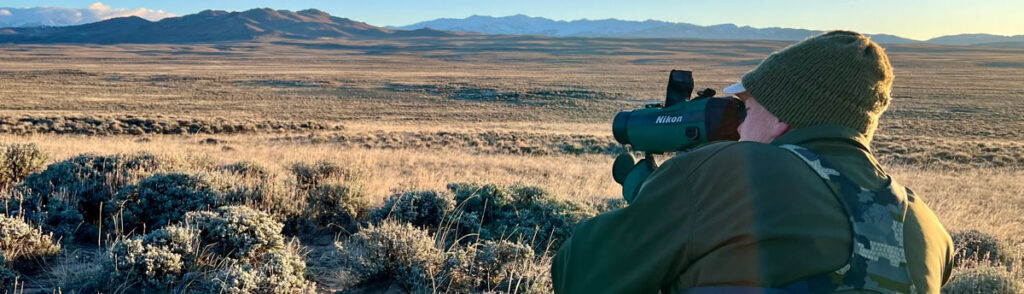
Tom Christiansen, longtime Wyoming state sage-grouse coordinator, observes a lek on an early spring morning. Photo credit: Tom Christiansen
Also, any and all plans, including those of the states, must make a commitment to transparency and collaboration in managing the sage-grouse habitat. Open data sharing across administrative boundaries is essential in fostering an inclusive environment where scientists, policy makers, and the public can access and contribute to the ecological data that guides management decisions. This approach not only enhances the trust and cooperation among stakeholders but also strengthens the scientific basis for those decisions and provides defensible evidence of the successes and failures of management actions.
Here in Wyoming, we are lucky to still have some relatively intact landscapes that rise above others in terms of their value to sage-grouse and associated species. I support efforts to secure the most effective safeguards for these “best of the best” areas, which are resistant to impacts like invasive species and resilient in their ability to return to good habitat after an impact such as wildfire. These landscapes are the cornerstones upon which the survival of the sage-grouse depends. Irreplaceable places, such as the Golden Triangle in western Wyoming, have such high biological value that these habitats must receive the highest level of conservation.
The current proposal by the BLM to update its sage-grouse management plans is an important step forward. By focusing on strategic habitat management, implementing open data practices, and utilizing advanced adaptive management tools, we can forge a sustainable path for the sage-grouse. This approach will not only benefit the bird but also the myriad other species and human communities that rely on a healthy sagebrush ecosystem. It’s a chance to reaffirm our commitment to conserving a vital part of our natural heritage thereby ensuring that we hand these natural resources in good condition to future generations.
Historically our record is less than stellar when it comes to grouse conservation. The heath hen of the eastern coastal barrens is extinct. The highly endangered Attwater’s prairie chicken is hanging on by a thread along the Texas Gulf Coast. And lesser prairie chicken populations in the southern Great Plains are now listed as threatened or endangered. Our success or failure with greater sage-grouse will be measured by whether or not we maintain enough of the remaining sagebrush sea so that the primal, guttural sounds of strutting sage-grouse continue to punctuate the clear, cold air of spring sunrises across the West.
Tom Christiansen retired after a 33-year career with the Wyoming Game and Fish Department where he served as a regional wildlife biologist and then as the statewide sage-grouse program coordinator. Tom served on the Western Association of Fish and Wildlife Agencies’ Sage and Columbian Sharp-tailed Grouse Technical Committee, the Rangewide Interagency Sage-Grouse Conservation Team, and the Wildfire and Invasive Species Working Group. Like sagebrush, Tom’s roots run deep in Wyoming. His family has maintained continuous residence in Wyoming since 1885.
Tracking Congress: The Impact of 2024 Budget Allocations on Hunters and Anglers
Appropriators in Congress recently began passing fiscal year 2024 funding bills that contain both highlights and disappointments for conservation.
After arduous negotiations, Congress has finally started to pass funding bills for fiscal year 2024. These bills bring about significant changes to the funding levels of programs that hold a special place in the hearts of hunters and anglers. Listed below are some highlights and disappointments from the recently enacted federal spending bills.
Highlights
Robust Funding for Everglades Restoration
Everglades restoration has come a long way since the Comprehensive Everglades Restoration Plan was authorized by Congress in 2000. Harmful discharges from estuaries have been reduced, wetlands have been restored, and greater amounts of water are flowing from north to south. However, there is still work to be done, including the continued construction of the Everglades Agricultural Area Reservoir. When completed, the reservoir will hold overflows from Lake Okeechobee and filter the water before sending it south. This $425 million investment will boost Everglades restoration efforts and improve hunting and fishing opportunities.
Increased Funding for WaterSMART
WaterSMART grants provide financial assistance to water managers for initiatives aimed at conserving and optimizing water usage, implementing renewable energy, exploring water marketing tactics, mitigating conflict risks in high-risk water areas, and achieving other sustainability objectives in the western United States. The increased funding for WaterSMART grants will help safeguard habitats that sustain fish and wildlife and are important to hunters and anglers.
Increased Funding for Atlantic and Pacific Salmon for National Marine Fisheries Services
The populations of Atlantic and Pacific Salmon both feature endangered subpopulations. In the Pacific, this funding has led to stabilization and recovery of several subpopulations, such as the chum, Snake River Chinook, Lower Columbia Steelhead, and Lower Columbia River Coho salmon. These increased funds will continue to bolster habitat restoration, improvements to upstream and downstream fish passage, and other conservation efforts aimed at contributing to higher functioning watersheds and better-quality fishing opportunities for future generations.
Good Neighbor Authority Extended to National Park Service and U.S. Fish and Wildlife Service
Good Neighbor Authority allows federal agencies to authorize states, counties, and tribes to conduct land management and restoration projects on federal lands. GNA is a win-win-win as it enables federal agencies with limited capacity to partner with states, counties, and tribes to achieve large-scale forest, watershed, and rangeland health outcomes. By extending the GNA to the National Park Service and the U.S. Fish and Wildlife Service, hunters and anglers will continue benefiting from the collaboration it fosters to conduct land management and restoration projects on new swaths of federal land.
Disappointments
Funding Cuts at The Bureau of Land Management
Among the Bureau of Land Management programs receiving funding cuts are the Recreation Management program, Resource Management Planning program, Rangeland Management program, Wildlife Habitat Management program, and the Aquatic Habitat Management program. The funding cuts will impact the BLM’s ability to help manage and improve vast amounts of public land for hunting and fishing.
Funding Cuts to the National Wildlife Refuge System
For the past fifteen years, the National Wildlife Refuge System has functioned with a Fiscal Year 2010 budget. Not once in a decade and a half have their funds been adjusted for inflation, and this lack of investment is reflected in the number of full-time staff diminishing even as the system expands. Low staffing levels directly affect the system’s ability to conduct habitat restoration and management, provide visitor services, and support law enforcement. The National Wildlife Refuge System budget saw a 3% budget cut from 2023, which means more staff dedicated to managing these public lands, and the hunting and fishing opportunities they provide, will be lost.
Funding Cuts at The U.S. Geological Service
The U.S. Geological Service saw cuts of up to 5% for its scientific research programs focused on Chronic Wasting Disease, controlling invasive species, and adapting to climate change. Investment in CWD research is essential as the always-fatal disease has now been detected in 32 states. The cost to control and eradicate aquatic invasive species in the U.S. amounts to more than $100 billion each year.
Funding Cuts at The U.S. Forest Service
The Wildlife and Fisheries Habitat Management, and Recreation, Heritage, and Wilderness initiatives of the USFS received cuts of up to 20%. These cuts will hamper the ability of USFS to manage habitat on their lands, and research best practices to manage forests and reduce wildfire risk. The Wildlife and Fisheries Habitat Management funding goes towards restoring fish and wildlife habitat, conserving threatened species, and maintaining wildlife habitat connectivity on USFS land. The Recreation, Heritage, and Wilderness initiative provides funds for improving access to and recreation on USFS land, including planning resources, trail management, and the off-highway vehicle program.
Hunters and anglers have always been the unsung heroes of conservation in America, quietly paying it forward every time we buy a license, a box of ammo, or a tank of boat fuel. We know you’re not satisfied with simply going hunting or fishing and then going home—so go the extra distance. You can take action on the conservation issues that matter right now.Click here to get started.
Driven by legal challenges, these draft amendments are intended to update plans previously finalized by the BLM in 2015 and 2020, and they will direct management across 10 Western states that cover the current range of the greater sage grouse.
“The Theodore Roosevelt Conservation Partnership, along with hunters and anglers across the West, understand the importance of well-managed BLM lands for the longevity of greater sage grouse and other sagebrush obligate species,” said Madeleine West, TRCP’s director of the center for public lands. “And while there’s a clear need to complete these latest plan amendments, the focus of federal and state agencies, along with external partners, must quickly shift to implementing conservation strategies on the ground.”
These plan amendments offer the opportunity for the BLM to incorporate new science to inform land management decisions. A 2022 U.S. Geological Survey report revealed that half of the original sagebrush ecosystem has been lost at a rate of approximately 1.3 million acres each year over the last two decades.
The sagebrush ecosystem is the largest terrestrial biome in the Lower 48 at over 165 million acres spanning 13 Western states. It is home to the iconic greater sage grouse as well as numerous other fish and game species. Greater sage grouse conservation efforts have driven unprecedented collaboration between state and federal managers, private landowners, and NGOs for multiple decades. This continued collaboration is critical to reverse the trend of significant habitat loss, which impacts individual species like the greater sage grouse, as well as communities across the West.
Today’s announcement kicks off a 90-day formal comment period where the public can submit scoping comments that will be used to inform revision of the draft plan amendments, which are expected to be finalized by the end of 2024.
“TRCP will be digging into the details of the draft plan amendments to provide constructive comments that ensure successful and durable conservation measures can be implemented on BLM-managed lands that support the greater sage grouse, the myriad other species that benefit from healthy sagebrush habitat, as well as the diverse communities that rely on these public lands,” added West.
Read more about TRCP’s work on greater sage grouse conservation HERE.
HOW YOU CAN HELP
TRCP has partnered with Afuera Coffee Co. to further our commitment to conservation. $4 from each bag is donated to the TRCP, to help continue our efforts of safeguarding critical habitats, productive hunting grounds, and favorite fishing holes for future generations.