
by:

posted in: Menhaden

November 20, 2025

Fact or Fiction: Debunking Gulf Menhaden Industry’s Deceptive Claims

The menhaden reduction industry has frequently and publicly tried to justify its Gulf harvest levels, destructive practices, and fishery management decisions in its favor; here TRCP breaks down its misleading claims

Last week, we posted a similar blog focused on misinformation coming from the menhaden industry on the Atlantic.  In this blog, we’ll focus on misinformation peddled by the industry in the Gulf.  

The menhaden reduction industry has benefitted from recent decisions affecting fisheries management on the Atlantic and Gulf coasts – with science-based cuts to catch quota being ignored and buffers that protect nearshore habitat and reduce bycatch slated for reduction. These decisions were guided by politics much more than science or public support. And that’s a problem, because menhaden are critically important bait fish that are preyed on by gamefish like redfish and tarpon, and sportfish like speckled trout, jacks, mackerel, and striped bass and serve as a necessary foundation for healthy ecosystems. 

Despite these discouraging outcomes, the menhaden industry is seeking public sympathy in interviews with the media and in public hearings, complaining about financial woes and potential industry job cuts while boasting that they are committed to sustainable fisheries and healthy ecosystems. But is any of that actually true? 

Recreational anglers and conservationists need to stay informed of the facts in the ongoing debate around menhaden management in the Atlantic and Gulf. Understanding complex fisheries management concepts is also important even when just assessing menhaden reduction industry-generated talking points in the “news” (which often isn’t news at all, as 2025 has seen a landslide of paid placements or “sponsored content,” and claims unvetted by journalists that appear on well-known news websites with only small disclaimers attached). 

These misrepresentations matter because they’re already influencing management choices. One of the most consequential – and concerning – developments is happening right now in Louisiana. 

Photo: David Mangum

Louisiana Moves to Allow Near-Shore Industrial Fishing

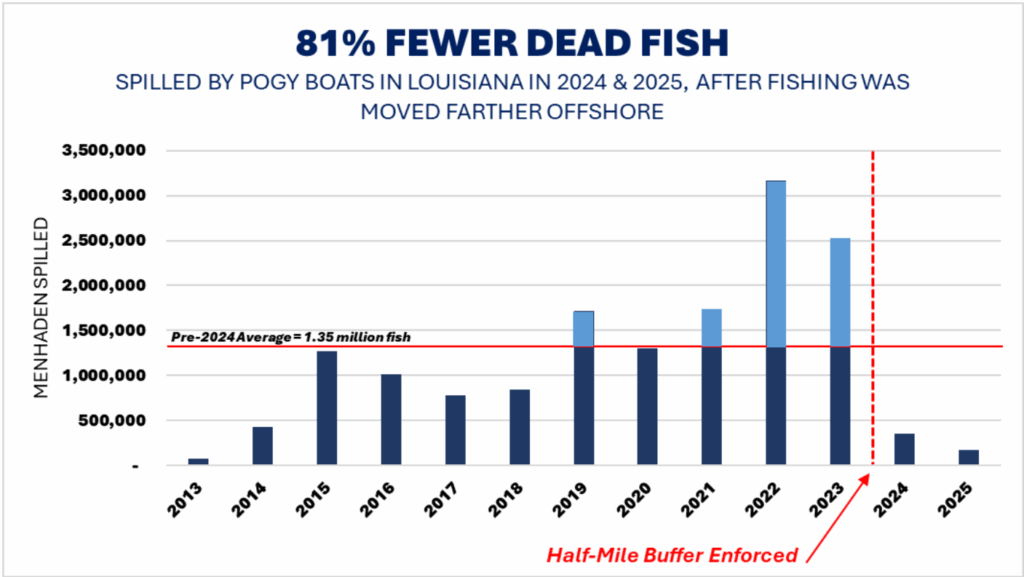
Two weeks ago, under industry pressure, the Louisiana Wildlife and Fisheries Commission (LWFC) voted to proceed with a Notice of Intent to reduce an existing half-mile buffer zone preventing industrial menhaden fishing near Louisiana’s coast to just a quarter-mile in most locations. This decision disregarded data that show the half-mile buffer is preventing fish kills that waste hundreds of thousands of menhaden (more commonly called “pogies” in the Gulf) as well as thousands of redfish and other pogy predators annually. It also largely ignored a recent study that showed industry bycatch of redfish and other important gamefish species is more likely in shallower, near-shore waters. 

Below are menhaden reduction industry claims we’ve seen in the media and/or in public meetings recently that require clarification. 
Industry Propaganda in the Gulf

Industry Claim (from LWFC meeting on Nov. 6): “The current buffer zone is cutting profits and workers’ jobs are at risk. Our fleet can’t catch enough fish elsewhere besides the area within a half-mile from shore to make enough money to maintain our financial performance.

This claim is blatantly false, according to NOAA Fisheries data. 

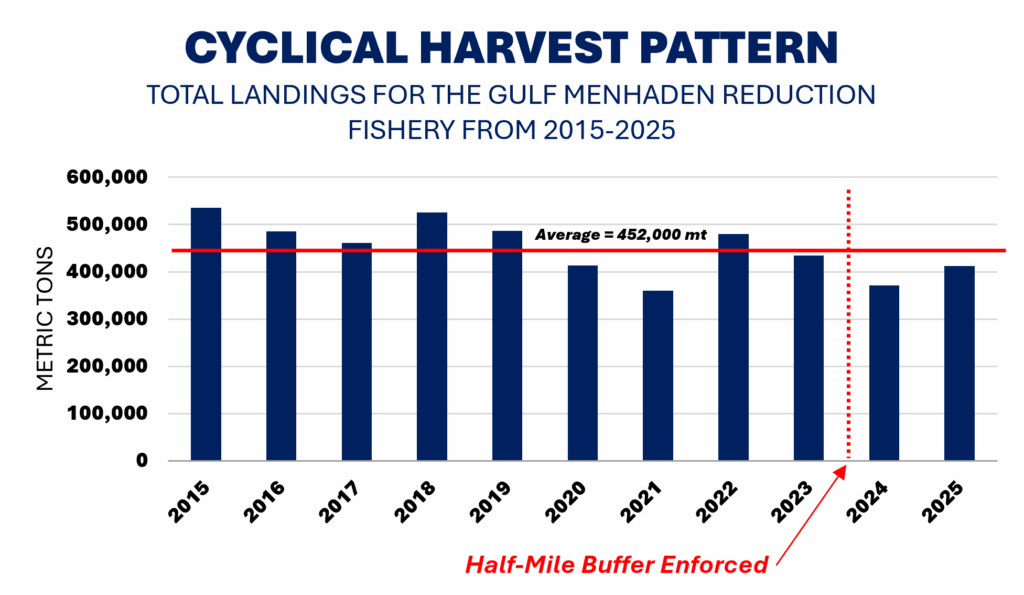
  • The menhaden industry has not provided concrete economic evidence for why the half-mile buffers should be reduced. They caught essentially the same number of fish in 2024 and 2025 while the buffers were in place as they did in 2020 and 2021 without the buffers. Further, since 2024, the value of their menhaden landings has actually increased by $60 million. And, in 2025 before even counting October’s harvest, the industry has already exceeded its 2024 catch by 93 million pounds.  
  • The industry is not only clearly catching plenty of fish, since they weren’t complaining about having to cut jobs in 2020 and 2021, they are also increasing their total revenue as the value of each fish caught is higher than ever.  
  • The industry is allowed to fish anywhere else besides inside the small buffer zone within a half-mile from shore (and a wider buffer of 1-3-miles in a few small areas off public beaches). Not only do they have full access to every other expanse of water in the Gulf and most areas inside Breton and Chandeleur Sounds besides this tiny, fragile nearshore area, but they have no limit to how many fish they can catch each year. Logic would dictate that they should be able to catch plenty of fish elsewhere, and that implying that the strip of area between ¼ and ½ mile from shore will make or break their financial performance is a sign of greed rather than need. 

Industry Claim: “The results of a 2024 bycatch study funded by Louisiana ‘reaffirm what decades of science have consistently shown: Louisiana’s Gulf menhaden fishery is sustainable, selective, and not a threat to red drum populations.’” 

This claim is short-sighted. 

  • While the industry catches fewer non-target species than the maximum legal bycatch rate of 5 percent by weight, they are still catching more than 146 million fish as bycatch annually, according to the 2024 data, including more than 30,000 redfish (22,000 of which are spawning size, which is illegal for all Louisiana anglers).  
  • In the areas where industry wants to roll back the buffers, redfish bycatch is highest during the spawning season from August-October, with up to 50 percent of the female redfish caught as bycatch actively spawning. The loss of redfish spawning potential to the state with even less protection in those areas could be very detrimental to overall redfish numbers as Louisiana tries to increase the redfish populations coast-wide.   
  • In addition, the pogy industry kills  240,000-plus speckled trout , 81 million croaker, 25 million white trout, and 12 million spot each year. These are species not just sought by recreational anglers but also forage species that Louisiana predators rely on. So, the menhaden industry not only impacts the menhaden population itself, but populations of many other forage species critical to the ecosystem.  
Industry Claim: “The fishery harvests less than 2 percent of the total Gulf menhaden biomass – helping to maintain ecological balance while preserving a key food source for marine predators.” 

This claim does not tell the full story. 

  • This assertion misrepresents what “total biomass” actually means and how fishing impacts the menhaden population. This claim is relevant for all ages of menhaden — from juveniles to spawning-capable adults — but the industry targets adult fish. If you consider how much of the spawning stock is removed each year, rather than total biomass, it becomes clear that the industry harvests a much higher percentage of the adult menhaden population.  
  • In fact, based on the 2024 Gulf menhaden stock assessment, between 2013-2023 the industry removed between 12-27 percent of the age-1+ biomass, and between 36-70 percent of the age-2+ biomass. Gulf menhaden don’t fully mature for two years, but nearly a quarter of the annual catch also includes fish that have escaped the marsh nursery grounds but have not yet spawned.  Also, 70 percent of the harvest for the entire Gulf comes from Louisiana state waters. That level of localized depletion has not been studied to analyze its effects.   
  • Comparing menhaden harvest to total biomass including fish less than one year old underestimates the pressure the fishery puts on the harvestable stock. This downplays the true ecological impact of the fishery because it ignores age structure, recruitment, and the proportion of adult fish removed from the population each year. 

Next Steps 

We know fisheries science and management definitions, concepts, and outcomes can be hard for anyone to understand, making it difficult to determine the best decisions for fisheries we care about. We encourage you to reach out to TRCP if any fisheries jargon ever needs to be better explained to help protect menhaden and the sportfish that depend on them.   

Stay tuned for information about how you can weigh in on upcoming menhaden management decisions to shape where the fishery is headed.  Learn more about these small fish with a mighty purpose by visiting TRCP’s Forage Fish Recovery Page

Banner image courtesy David Mangum
2 Responses to “Fact or Fiction: Debunking Gulf Menhaden Industry’s Deceptive Claims”

  1. Garth Walker

    Deception and lies are the tools of omega protein! They sit on the board at the very head of the gulf State Marine fisheries commission! Omega, protein, scientist, or so-called scientist, provide all the information to NOAA ! Everything is rigged in their favor from the beginning!

  2. Pierrepont

    Recent scientific proof in the Atlantic that stock sizes were way over estimated is surely true for the gulf as well given the gulf science mirrored the Atlantic. The excessive catch is being allowed by politicians that take significant contributions from the industry. I wish La
    Mary would indicate how Louisiana voters could offset the industries influence , so recreational fishing interest that are valued in the billions are recognized.

Do you have any thoughts on this post?

XHTML: You can use these tags: <a href="" title=""> <abbr title=""> <acronym title=""> <b> <blockquote cite=""> <cite> <code> <del datetime=""> <em> <i> <q cite=""> <s> <strike> <strong>

Comments must be under 1000 characters.

by:

posted in: Menhaden

November 13, 2025

Fact or Fiction: Debunking Atlantic Menhaden Industry’s Deceptive Claims

The menhaden reduction industry has frequently and publicly tried to justify its harvest levels, destructive practices, and fishery management decisions in its favor; here TRCP breaks down its misleading claims

The menhaden reduction industry should by all counts be very happy with the outcome of recent decisions affecting fisheries management on the Atlantic and Gulf coasts – with science-based cuts to catch quota being ignored and buffers that protect nearshore habitat and reduce bycatch slated for reduction. Meanwhile, anglers and conservation advocates continue to scratch and shake their heads at decisions guided by politics much more than science. After all, nutrient-dense menhaden play a central role in marine food webs as baitfish providing an essential food source for economically important sportfish like striped bass, redfish, tarpon, and bluefin tuna, as well as predators like whales and ospreys.

Despite these discouraging outcomes, the menhaden industry is seeking public sympathy. In interviews with the media and in public hearings, its representatives say they have been and will continue to suffer financially, that they could face job cuts, and that they are committed to sustainable fisheries and healthy ecosystems. But is any of that actually true?

As recreational anglers and conservationists, it’s important that we all stay well informed of the facts when engaging in the ongoing debate around menhaden management in the Atlantic and Gulf. Understanding complex fisheries management concepts is also important even when just assessing menhaden reduction industry-generated talking points in the “news” (which often isn’t news at all, as 2025 has seen a landslide of paid placements, and claims unvetted by journalists, that appear on well-known news websites with only small disclaimers attached).

In this blog, we’ll focus on misinformation peddled by the industry on the Atlantic front. Next week, we’ll offer a similar post that focuses on the Gulf.

Chris Crippen/Virginia Institute of Marine Science

Recent Vote on Atlantic Menhaden Ignores Science

As we reported two weeks ago, the Menhaden Management Board of the Atlantic States Marine Fisheries Commission (ASMFC) failed to cut the 2026 Atlantic menhaden quota by nearly enough to acknowledge the latest science showing that the menhaden population is far lower than previously estimated. Instead of the more than 50 percent cut necessary to rebuild the Atlantic striped bass population and support menhaden’s ecosystem role, only a 20 percent quota cut was made – which will not lower coastwide harvest for the menhaden reduction industry at all, based on 2024 commercial landings.

Below are a few major claims that we’ve seen in the media recently that deserve a serious second look.

Industry Propaganda in the Atlantic

Industry Claim: “Maintaining the status quo or making, at most, a modest, precautionary trim is consistent with risk policy; in particular, a reduction on the order of 10% eliminates overfishing risk in 2026 and remains extremely low if carried forward, so deeper cuts are not supported by the risk framework.”

This claim doesn’t tell the real story.

  • Within the Atlantic menhaden management framework, the ASMFC uses an ecosystem-based “fishing mortality threshold” to define whether menhaden are undergoing overfishing or not. There is a range of fishing pressure for menhaden between an ecosystem-based “target” and threshold which the Menhaden Management Board has the ability to choose from, each option representing various levels of risk for overfishing. The ecosystem-based target is just what you’d imagine, a target or best-case scenario for fishing mortality, that won’t remove too many fish from the water. The threshold, on the other hand, represents the highest level of fishing mortality that the Board can allow before the fishery is considered to be undergoing “overfishing,” thus warranting corrective action.
  • A fishing mortality rate below the ecosystem-based target would be the most precautionary scenario, where we can be pretty sure, based on the science available, that we have enough menhaden in the water to feed striped bass and other predators. ASMFC assumed we were at this level based on the previous science, but with this new stock assessment, realized that they erred in their estimations and that fishing mortality was/is above the target.
  • A fishing rate above the target, but below the threshold, is a riskier scenario. This is where there are still menhaden being left in the water for predators, but not enough to support striped bass if they were at a rebuilt biomass. This level is where we have previously been fishing at, based on the new stock assessment update, and where the 2026 fishing level will be as well. So, not enough for striped bass if they were at their full biomass target.
  • Only a fishing rate above the threshold is considered “overfishing,” and would warrant Board action to decrease menhaden fishing pressure. Even keeping the same coastwide quota that we’ve had for the past 3 years in 2026 would present essentially zero risk of crossing the threshold, so the Board is not worried about overfishing from a technical standpoint. Where the rubber meets the road is that we now know that even with the recent 20 percent quota decrease, more menhaden will be taken out of the water than should be left to support striped bass populations as they rebuild over the next few years.
  • If menhaden harvest ever reaches its fishing mortality threshold, striped bass numbers will fall even more, even if striped bass themselves continue to be fished at or below their own mortality target. While this scenario is not likely with a 20 percent quota cut, which is what the industry touts, the contradiction of minimal conservation measures made for menhaden – a food source critical for striped bass – with the extreme striped bass management measures anglers have made sacrifices for, for years now, is alarming.

Industry Claim: “There will likely be some operational adjustments required at our Reedville [Virginia menhaden processing and reduction fleet base] facility to comply with a 20 percent harvest reduction.”

This claim is conspicuously misleading.

  • Omega Protein/Ocean Harvesters will not feel the hit of this quota reduction, while other Atlantic states with menhaden bait fisheries will. The move to reduce the coastwide quota by 20 percent was not based on science or the ASMFC’s ecosystem-based framework, but was a number originally put forward by the ASMFC’s Virginia delegation, because it would not materially impact the Commonwealth’s landings.
  • The reality is the reduction industry has not been able to meet their full quota in years, and is catching around 80 percent of their current allocation (in other words, 20 percent less than the current quota, or the full amount of the new quota set for 2026). Likely, the only reason Virginia representatives were against the measure in the final vote was because it was a one-year decision, rather than one that would have given the reduction industry three years of fishing at this set quota.
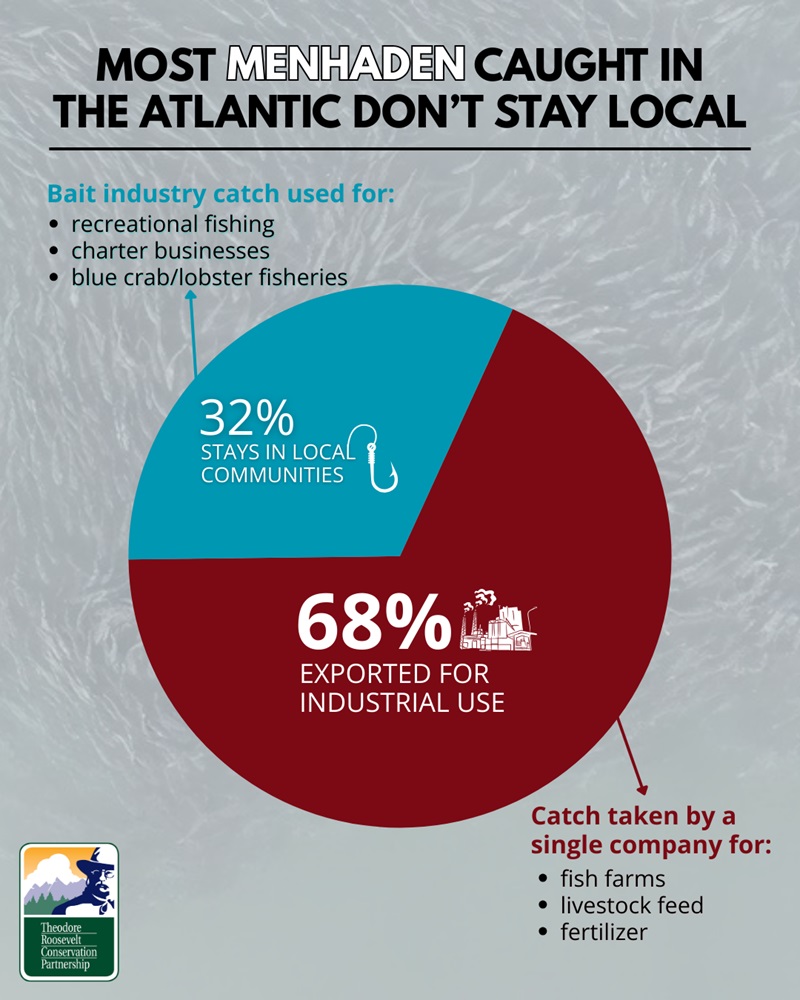
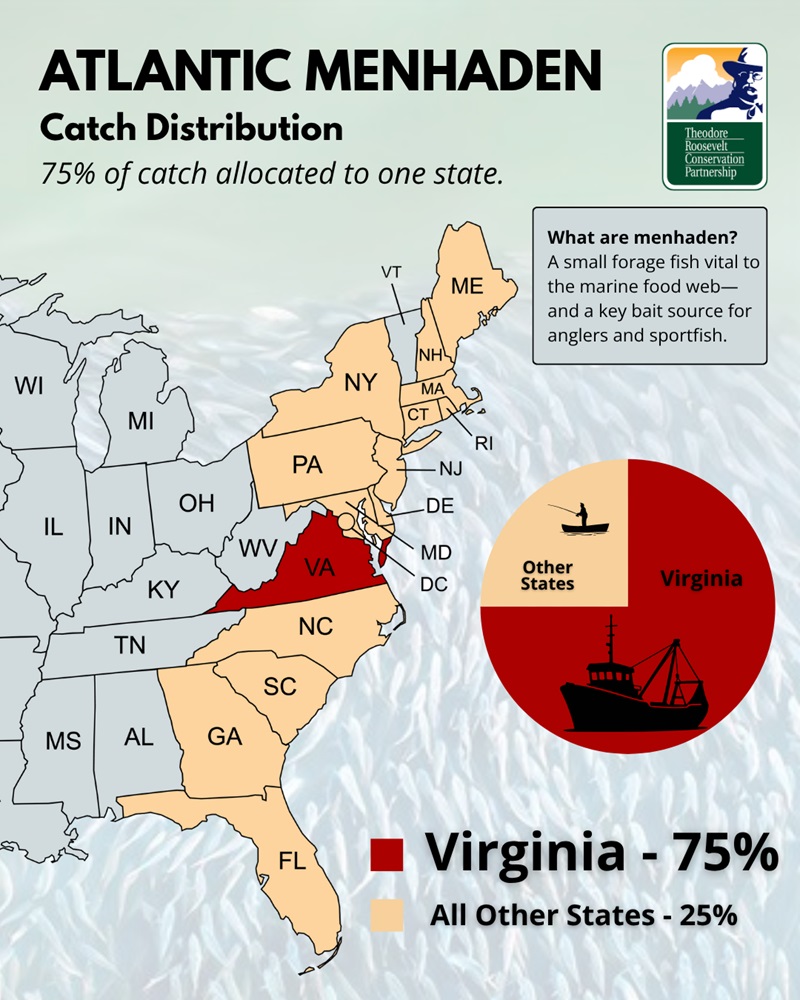
  • So the new quota will not significantly cut coastwide harvest or Virginia’s harvest, but where the cuts will actually be felt is by the states with active bait fisheries in the north, such as in Maine, who have to settle for the leftovers after the reduction industry (one company) gets nearly 70 percent of the allowable menhaden catch.
  • The industry frequently makes claims that any impacts to their ability to catch menhaden will cost jobs. But what wasn’t taken into consideration by the Board was that striped bass anglers have taken significant cuts to their striper access for many years now – which hurts jobs in the charter fishing, bait/tackle, tourism, and boating industries. Those sacrifices seem in vain now, since no matter what happens with striped bass catch, we aren’t leaving enough forage in the water for stripers to reach their biomass target by 2029.

Industry Claim: “We support moving forward with targeted new Bay science to guide any future Chesapeake Bay-specific decisions, so that upcoming choices are grounded in robust, transparent analysis.”

This claim is hypocritical on its face.

  • For the past three years, Omega Protein/Ocean Harvesters has actively lobbied against efforts in Virginia to fund science projects that would guide menhaden management in the Bay. These are projects that they were involved in developing with other stakeholder groups and state scientists from the very beginning.
  • Bay-specific menhaden management should be grounded in science and transparency, but the industry is clearly only interested in biased science to benefit their own agenda, because not so coincidentally, just before this past ASMFC meeting, the industry’s self-funded research group announced its own project to determine the scientific basis for their Bay fishing cap, rather than rely on an publicly funded study. Sound fishy to you?
  • The 2025 stock assessment update showed very clearly that cuts to the coastwide menhaden quota were necessary moving forward to maintain the integrity of the ecosystem-based framework that the industry claims it supports. In 2022, when the science then indicated a quota increase was possible, the industry was fully on board with using the science to their advantage to be able to catch more fish. Now, when the science suggests a major quota reduction is in order, the industry decided it didn’t want to follow the science anymore.

Next Steps

Fisheries science and management definitions, concepts, and outcomes can be hard for anyone to understand. That makes it that much more difficult to determine if decisions that can affect fisheries we care about are good ones, or bad. We hope this breakdown of the facts has been helpful and encourage you to reach out to TRCP if there’s anything else we need to focus on to best arm you with the knowledge necessary to help protect menhaden and the sportfish you care about.  

Stay tuned for a similar blog next week on misinformation coming from the Gulf menhaden industry, and for information about how you can weigh in on recent menhaden management decisions and shape where the fishery is headed.

Banner image courtesy Joanna Steidle

by:

posted in: Menhaden

November 6, 2025

Louisiana Decision Undermines Hard-Won Conservation Measure on Menhaden Fishing  

The new Notice of Intent could once again permit industrial menhaden harvest in waters as shallow as five feet – rolling back a successful 2024 conservation measure developed through collaboration between anglers, industry, and state leaders

The Louisiana Wildlife and Fisheries Commission (LWFC) voted 4-3 today to move forward with a Notice of Intent (NOI) that could allow industrial pogy boats to again fish within a quarter-mile of most Louisiana beaches – eliminating a broader half-mile buffer zone that the industry agreed to in 2024 after negotiations with recreational angling and conservation groups, LWFC,  and the Louisiana Department of Wildlife and Fisheries.

Despite overwhelming public opposition – including testimony, written comments, and letters from nearly 200 Louisiana-based and national conservation organizations and fishing tackle companies urging the LWFC to keep industrial fishing for pogies – also called menhaden – at least ½-mile off Louisiana’s coastline, the LWFC sided with the two foreign-controlled menhaden companies operating in the state.  

“Today’s decision is extremely disappointing for anglers, conservationists, and those who care about Louisiana’s coastal ecosystems and habitat,” said Chris Macaluso, director of fisheries for the Theodore Roosevelt Conservation Partnership. “In 2024, anglers, conservationists, and the menhaden industry reached a compromise to establish modest protections for Louisiana’s shallow coastal waters by setting a half-mile buffer off most Louisiana beaches. What happened today is nothing less than the industry and their political allies backing out of that deal.”  

Commission Chairman Kevin Sagrera of Abbeville, La. – where Canadian-owned Omega Protein owns one of its two Gulf-based processing plants – instructed Louisiana Department of Wildlife and Fisheries staff in October to draw maps that reduced the ½-mile buffers to ¼-mile across most of the coast at the behest of the industry. The other industrial menhaden company operating in the Gulf is South African-controlled Daybrook Fisheries, which runs a processing plant in Empire, La.  

The ½-mile buffers were enacted prior to the 2024 menhaden fishing season after two massive fish kill events were caused by the industry’s boats, as well as net tears in 2022 and 2023, that resulted in wasting millions of dead pogies, redfish, croakers, and other fish that washed up on Louisiana beaches. Menhaden reduction vessels draft around 10 feet, but will now again be permitted to fish in water as shallow as 5 feet if the NOI is ultimately approved in spring 2026. 

“What happened today not only undermines public trust in our state’s ability to conservatively manage its fisheries but will ultimately result in harm to fragile coastal habitats and fish like redfish and speckled trout, whose populations have already declined over the past decade.”

The Theodore Roosevelt Conservation Partnership analyzed menhaden industry-related fish kill and spill information from 2024 and determined that the estimated number of fish spilled was reduced by 74 percent after the ½-mile buffer was instituted. Menhaden harvest data from NOAA Fisheries database also revealed that – despite industry claims that the buffers were resulting in a loss of jobs, profits, and fewer fish harvested – 2024 harvest levels were similar to levels during the 2021 and 2014 fishing seasons and that the dockside value of the Gulf menhaden harvest increased by a full $60 million from 2021-2024.

2024 study that thoroughly examined bycatch associated with the Gulf industrial menhaden fishery showed that more than 140 million non-target fish were killed along with menhaden by industrial vessels that year alone, including 22,000 breeding-size redfish (which are illegal to harvest by recreational anglers), 240,000 speckled trout, more than 80 million croaker, 25 million white trout, 5.5 million white shrimp as well as millions of other species like spot, black drum, catfish, sharks, and rays. An additional 8,000 smaller redfish, Louisiana’s only saltwater gamefish, were killed and along with menhaden reduced by the industry into fish oil, fish meal, and other industrial products. The 2024 study also showed that bycatch of speckled trout, redfish, and other species increased in net sets made in water shallower than 22 feet deep.  

The LWFC was set to approve a 1-mile buffer coastwide in early 2024 after extensive public outcry about the millions of dead fish spoiling on Louisiana’s beaches in the previous two seasons. That decision was delayed by Louisiana Governor Jeff Landry’s administration, which eventually insisted both recreational fishing and conservation advocates, along with the menhaden industry, accept a ½-mile buffer as a compromise.

The vote to reduce the current ½-mile buffer will include a 60-day public comment period to begin on December 19 and conclude on January 23, 2026.  Should the LWFC give final approval to the NOI after the comment period, the Louisiana Legislature has the option to conduct an oversight hearing of the decision and could remand the decision back to LWFC for changes, if deemed necessary. 

More information about the broad importance of menhaden is available on TRCP’s Forage Fish Recovery Page 

by:

posted in: Menhaden

October 28, 2025

Marine Fisheries Board Declines to Make Science-Based Reduction to Atlantic Menhaden Catch Limit  

Revised models indicate the need to cut commercial quota by more than half to rebuild striped bass populations, but ASMFC Menhaden Management Board vote today reduces catch limit by a mere 20 percent 

Despite a 2025 stock assessment indicating that Atlantic menhaden biomass is one-third lower than previously estimated – and an immediate need to cut the coastwide menhaden quota by more than 50 percent to support striped bass rebuilding – the Menhaden Management Board of the Atlantic States Marine Fisheries Commission voted today to reduce 2026 commercial catch by only 20 percent. The decision, which will likely prevent striped bass and other predators largely reliant on menhaden like bluefish, weakfish, spiny dogfish, and ospreys from having sufficient forage, was a disappointment for conservation and recreational angling organizations.  

“Rebuilding the Atlantic striped bass population has always involved more than just regulating striped bass harvest. It’s also about ensuring that enough of their key food source, Atlantic menhaden, remains available in the water,” said Chris Macaluso, director of the Center for Fisheries for the Theodore Roosevelt Conservation Partnership. “The Menhaden Management Board’s decision to adopt only a 20 percent reduction in menhaden harvest, despite the science and input from ASMFC’s own scientists who highlighted the risks, makes it more challenging to achieve striped bass recovery by 2029. This step falls short of fully advancing more than a decade of progress toward ecosystem-based management and undermines public trust in the process.”

Three years ago, the Menhaden Management Board voted to increase the Atlantic menhaden catch limits for the 2023-2025 fishing seasons when the best available science indicated it was warranted.

The Board’s decision, made at the agency’s annual meeting in Delaware, ignores its own management framework based on “ecological reference points” (ERPs) — clear, science-based limits that tie menhaden harvest directly to predator health – and new estimates that show there are 37 percent fewer menhaden off the Atlantic coast than previously estimated. The Board also declined to vote for additional coastwide menhaden quota reductions beyond the 2026 fishing season, dodging additional quota cuts for 2027 and 2028 that could have collectively reached an ERP-based reduction that the recreational angling community called for after three years. The Board instead favored revisiting the issue in 2026 to determine if additional reductions are needed.

Notably, three years ago the Menhaden Management Board voted to increase the Atlantic menhaden total allowable catch for the 2023-2025 fishing seasons when the best available science indicated it was warranted. However, now that the best science indicates a reduction in catch is needed, the board has declined to reduce the catch to align with the ecosystem-based management model. 

In early October, the ASMFC released its 2025 Atlantic menhaden stock assessment update, which indicated that the coastwide menhaden biomass is lower than previously estimated and suggested that slashing the coastwide catch limit by more than half would be necessary to ensure sufficient forage for rebuilding populations of striped bass. The Board’s decision today is not expected to achieve the standard 50/50 probability of not exceeding the ERP fishing mortality target – the precautionary approach that would dictate risk-tolerant, science-based management – and instead results in a 100 percent chance of exceeding the target in 2026.

“Today, the Menhaden Management Board chose to abandon ecosystem-based management and will be leaving less menhaden in the water to fuel our coastal ecosystems and sportfishing economies,” said Ted Venker, conservation director for the Coastal Conservation Association.

Unlike traditional single-species models that only measure the health of one species like menhaden, ERPs explicitly weigh the tradeoffs between menhaden harvest and effects on predator populations — in this case, most notably striped bass, also known as rockfish.

TRCP and partners successfully advocated for ERPs to be considered in menhaden management starting in 2020. The expectation of all involved in the process was that this methodology would drive future management decisions, even though following ERPs is not mandated for the ASMFC.

“We will continue working with the ASMFC, anglers, and conservationists to ensure that menhaden harvest reductions go beyond 20 percent and align with the ecosystem’s needs and the board’s stated commitments,” Macaluso said.

The Menhaden Management Board also voted today to initiate an addendum to specifically address Chesapeake Bay Management, which will develop options for quota periods which distribute menhaden removals more evenly throughout the fishing season, as well as options to reduce the Chesapeake Bay Reduction Fishing Cap ranging from status quo to a 50 percent decrease. This process could yield significant benefits to the Bay ecosystem, which has faced multiple concerns in recent years, including osprey breeding failures due to chick starvation in many parts of the Bay.

More information about the broad importance of Atlantic menhaden is available on TRCP’s Forage Fish Recovery Page

Banner image courtesy David Mangum
by:

posted in: Menhaden

October 15, 2025

Menhaden Stock Assessment Indicates Catch Must Be Reduced to Benefit Striped Bass 

The 2025 Atlantic menhaden stock assessment updates connect menhaden harvest directly to the health of marine predators; ASMFC projections suggest cutting commercial catch limit by half

If you fish the Atlantic coast for striped bass, bluefish, or bluefin tuna, here’s the truth: your success depends on Atlantic menhaden. These small forage fish fuel the predators sought by recreational anglers and charter businesses, as well as whales, dolphins, ospreys, and many other species integral to a thriving food web.  

Last week, the Atlantic States Marine Fisheries Commission released the 2025 Atlantic Menhaden Ecological Reference Point Stock Assessment Report, which sets the stage for how Atlantic menhaden will be managed for the next few years. The update indicates that the coastwide menhaden biomass is lower than previously estimated and resulting projections now suggest that slashing the coastwide catch limit by more than 50 percent may be necessary to ensure sufficient forage for striped bass rebuilding. 

What Are ERPs & Why Do They Matter?

This latest benchmark stock assessment and peer review process for Atlantic menhaden uses ecosystem modeling to establish ecological reference points (ERPs) — clear, science-based limits that tie menhaden harvest directly to predator health. Unlike traditional single-species models that only measure the health of one species (how many fish there are, how fast they grow, how many are caught, etc.), ERPs explicitly weigh the tradeoffs between menhaden harvest and predator population outcomes — especially for striped bass. These numbers are our best tool to keep striped bass (also known as rockfish) and other sportfish thriving by ensuring they have adequate food left in the water.  

If we catch this many menhaden, what happens to the predators that rely on them?

A key outcome of “SEDAR 102,” the official name of the stock assessment update, is the update to ERPs. Utilizing ERPs means that menhaden are not just managed based on that sole fishery, but also through considering the needs of predators that eat them (i.e., striped bass), and the broader ecosystem. The assessment update draws on the best available science — everything from updated menhaden life history information to new predator diet data to account for complex predator-prey relationships. Importantly, both the latest single-species and ecosystem models went through independent peer review by external experts, and were found to be scientifically credible for management.

TRCP and partners successfully advocated for ERPs to be considered in menhaden management starting in 2020. With ERPs, the idea is: if we harvest menhaden at industrial scales, even if their own stock looks healthy, we might not leave enough in the water for predators that rely on them, like striped bass, bluefish, osprey, and bluefin tuna. In plain terms: ERPs help managers answer the question, “If we catch this many menhaden, what happens to the predators that rely on them?”

Photo Credit: David Mangum
Where We Stand Now

The ASMFC’s Menhaden Management Board should now approve these updated ERP values for management (a revised ERP fishing mortality target that balances menhaden harvest with the needs of striped bass and a new ERP “overfishing” threshold). The Board is gearing up to accept the new ERPs at their annual meeting on Oct. 28, and then update the coastwide total allowable catch for the 2026-2028 fishing seasons, based on those values.

The 2023 menhaden fishing mortality rate was estimated to be above the updated ERP target, meaning current menhaden fishing pressure won’t allow striped bass to rebuild to their biomass target. That tells managers that while neither stock is collapsing, the commercial menhaden fishery is removing more fish from the water than the ecosystem-based fishing target says will support striped bass rebuilding. In plain terms: menhaden are not technically “overfished” nor experiencing “overfishing,” but stripers and other predators aren’t getting all the menhaden they need to maintain healthy populations of their own.

Stripers Stand the Most to Gain (or Lose)

Rebuilding the Atlantic striped bass population isn’t just about regulating striped bass harvest. It’s also about ensuring that their main food source — Atlantic menhaden — is managed responsibly. The ERP framework is designed to link menhaden harvest levels directly to predator population outcomes. And no predator drives the ecosystem models more than striped bass.

Photo Credit: Tyler Nonn

Here’s the reality:

  • Unlike menhaden, striped bass are overfished. Their spawning stock biomass remains below target levels.
  • Menhaden are their primary forage. If menhaden fishing mortality levels rise above the ERP target, it reduces the availability of prey just when stripers need it most to rebuild.

So, fishing menhaden below the ERP fishing mortality target ensures sufficient forage is left in the water for striped bass rebuilding to be achieved. More food for stripers to grow, survive, and reproduce is exactly what’s needed to get the stock back on track.

Slashing the coastwide menhaden catch limit by more than 50 percent may be necessary to ensure sufficient forage for striped bass.

Why This Matters to Recreational Anglers

The ERPs give managers a roadmap to keep predators and prey in balance. But they don’t automatically trigger any fishery management changes. The coastwide menhaden quota still needs to be set, and projections by the Atlantic Menhaden Technical Committee indicate that the total allowable catch will need to be cut by over 50 percent to achieve even a 50/50 probability of not exceeding the ERP fishing mortality target next season. We know that Virginia’s menhaden reduction fishery will push for the allowable catch to remain high, but we can’t ignore what the updated ERP values indicate. The ERP target isn’t just a number on a chart — it’s a data-driven indicator that says: If we leave this much bait in the water, striped bass stand a chance to rebuild.

Remember, the new ERP values represent the best available science and rigorous peer review. Accepting these updated values is essential to:

  • Maintain the integrity of the ERP framework — the very system that puts predator needs at the heart of menhaden management.
  • Ensure sustainable menhaden harvests that don’t undermine the forage base critical to Atlantic predators.

If the Menhaden Management Board fails to adopt these science-based ERP values, the role of menhaden as a keystone forage species in the Atlantic ecosystem could be jeopardized — and recreational anglers will be among the first to feel the impact.

Two Possible Levers Toward One Outcome

The ASMFC has two main tools to help rebuild striped bass populations:

  • Reduce striped bass fishing mortality. The Atlantic Striped Bass Board has already acted, implementing new regulations that reduced striped bass fishing mortality to a 30-year low. In other words, anglers have already made sacrifices toward a solution.
  • Reduce menhaden fishing mortality. This is now the only key lever left for fisheries managers to support striped bass recovery.

If menhaden aren’t managed at or below the ERP fishing mortality target, striped bass rebuilding will remain constrained, no matter what’s done on the striped bass fishery side. Ecosystem models are complex, and uncertainty always exists in predator-prey interactions and environmental conditions. That’s why the ERP framework recommends a precautionary approach to leave a buffer of forage in the system to safeguard against uncertainty. This is the standard for managing a key forage fish — and it’s exactly what the peer-reviewed science supports.

What You Can Do
  • Stay informed: When you hear debates about updates to the coastwide quota, and see conflicting information about what should drive it, know that the latest ERP fishing mortality target is the line in the sand for predator health.
  • Speak up: Recreational voices matter at ASMFC and state agency meetings. Ask the Menhaden Management Board to accept the updated ERPs and set the 2026-2028 total allowable menhaden catch so there’s no more than a 50 percent chance of exceeding the ERP fishing mortality target. Anglers have a seat at this table — let’s use it.
  • Think long-term: More menhaden left in the water now means more fall striper blitzes, fatter fish, and better fishing in the years ahead for us and future generations.

For more information about how to tune in to the ASMFC annual meeting Oct. 27-30, when the Menhaden Management Board will discuss changes to the ERPs and total allowable catch as a result of the stock assessment update, visit the ASMFC meeting webpage.

HOW YOU CAN HELP

TRCP has partnered with Afuera Coffee Co. to further our commitment to conservation. $4 from each bag is donated to the TRCP, to help continue our efforts of safeguarding critical habitats, productive hunting grounds, and favorite fishing holes for future generations.

Learn More
Subscribe


You have Successfully Subscribed!

You have Successfully Subscribed!

You have Successfully Subscribed!

You have Successfully Subscribed!

You have Successfully Subscribed!